Children and adolescents in Chile face a growing wellbeing crisis. 73.6% do not meet recommended physical activity levels, and more than half are overweight or obese. At the same time, children have fewer opportunities to play freely, move, interact and connect with nature—experiences essential to their physical, socio-emotional and cognitive development.
Schools can be part of the solution, yet learning remains largely confined to classrooms, while schoolyards are often hard, uniform spaces with limited vegetation and opportunities for exploration, movement and diverse forms of play. This represents a missed opportunity, particularly for children with limited access to green spaces.
We created Patio Vivo because we recognized the potential of transforming an existing but underused educational resource. By turning schoolyards into Learning Landscapes, we seek to improve children's wellbeing and create better conditions for learning through nature, play, movement and outdoor experiences.
Our innovation begins with a simple idea: we do not need to create new places for children to learn and thrive; we need to transform the places they already inhabit every day.
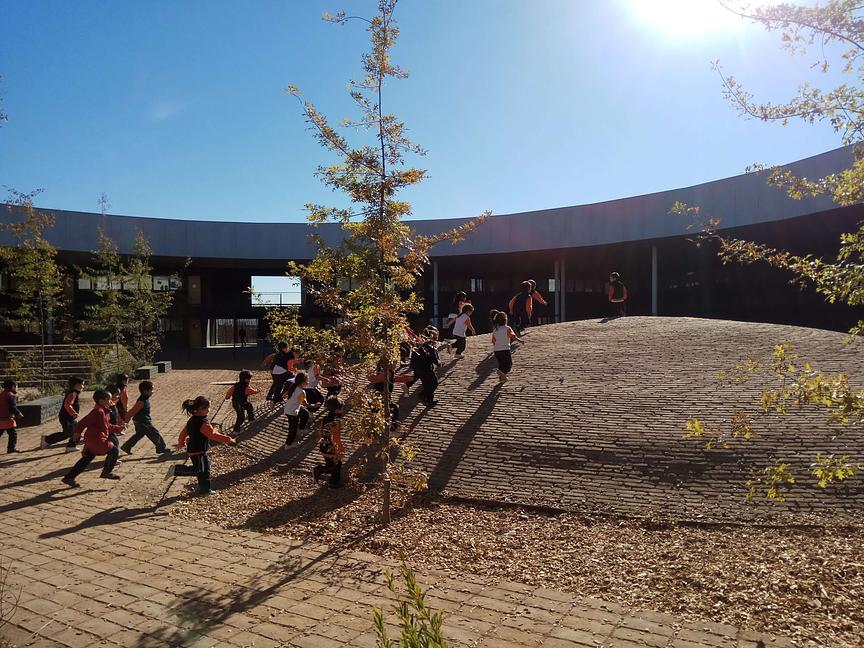
Patio Vivo transforms schoolyards into Learning Landscapes: educational environments that integrate nature, play, movement and outdoor learning to strengthen children's wellbeing and development.
Our methodology connects three dimensions: physical space, educational practices and school culture. Each project begins with a participatory diagnosis involving students, teachers, school leaders and families. Through a collaborative design process, we incorporate the community's needs, knowledge and local identity into a landscape with a clear educational purpose.
We use nature-based solutions, vegetation and multifunctional structures to create diverse opportunities for free play, exploration, physical activity, social interaction and outdoor learning. However, transforming the space is only the beginning. We train and support educators to integrate the schoolyard into everyday teaching practices, strengthening 21st-century skills, environmental awareness and experiential learning.
Our approach adapts to different ages, educational contexts and territories, from early childhood to secondary education, in both urban and rural communities.
By combining spatial transformation, community participation and pedagogical activation, we turn the schoolyard into a permanent educational resource that supports wellbeing, learning and connection with nature.
Since 2014, Patio Vivo has grown from a local initiative into a nationally recognized model for transforming school environments. We have implemented more than 170 projects across nine regions of Chile, reaching over 61,000 students in urban and rural communities.
Our methodology has expanded through partnerships with public education authorities, municipalities, foundations, companies and educational communities, combining public-private collaboration with local participation. This approach has allowed us to adapt our Learning Landscapes to different educational contexts and territories while strengthening their long-term sustainability.
Internationally, our work has been recognized by UNICEF, Children & Nature Network and HundrED, and shared through international conferences and networks, including COP28 in Dubai. These opportunities have helped position Patio Vivo within the global movement for greener, healthier and more inclusive school environments.
Our next challenge is to move from individual projects toward systemic impact: developing replicable methodologies, transferring knowledge and capacities to other organizations, strengthening impact measurement and influencing public policies that recognize play, nature and outdoor learning as essential to children's wellbeing and education.
We aim to consolidate our impact in Chile while becoming an international reference for educational innovation through nature-based Learning Landscapes.
Over the past twelve years, Patio Vivo has evolved from transforming the physical design of schoolyards into developing a comprehensive educational methodology that integrates nature, play, outdoor learning and wellbeing.
One of our most significant innovations has been incorporating teacher training and pedagogical support into the transformation process. We have learned that changing the physical environment is not enough: lasting impact requires strengthening educational practices, community participation and school culture.
We have also expanded our approach to different educational stages and contexts, from early childhood to technical-vocational secondary education, developing methodologies that connect experiential learning with sustainability, local knowledge and 21st-century skills.
More recently, we have strengthened our Monitoring, Evaluation and Learning (MEL) framework to measure changes in physical activity, free play, social interaction, contact with nature and sustainable practices. This evidence allows us to refine our methodology and demonstrate its contribution to children's wellbeing.
Today, we are developing more replicable and transferable approaches, combining educational resources, professional training and adaptable landscape solutions to reach more schools while maintaining the quality and depth of our impact.
The first step is to recognize the schoolyard as an educational resource with the potential to strengthen children's wellbeing, learning and connection with nature.
Our methodology begins with a participatory diagnosis that considers the school's educational goals, local context and the perspectives of students, teachers, school leaders and families. Based on this process, we collaboratively design a Learning Landscape that integrates nature, diverse opportunities for play, movement and outdoor learning.
The transformation combines landscape design and nature-based solutions with teacher training and pedagogical support, ensuring that the space becomes part of everyday educational practices.
Schools and organizations can work directly with Patio Vivo to implement the methodology or explore opportunities to adapt and replicate its principles in their own contexts. Our goal is not simply to transform a schoolyard, but to build the capacities and community engagement needed to sustain its educational impact over time.
To learn more or explore a collaboration, contact us at info@patiovivo.cl or visit www.patiovivo.cl.