STEAMathon Qatar was created to address a persistent gap in education systems: the disconnect between theoretical learning and real-world application. While students study STEM subjects, they often lack structured opportunities to apply their knowledge to solve meaningful challenges, particularly those related to sustainability and national development priorities.
In Qatar, this gap is particularly relevant given the country’s ambitions to transition toward a knowledge-based economy under Qatar National Vision 2030. There was a need for an approach that not only builds knowledge, but also develops innovation, problem-solving, and research capabilities among students.
The initiative was designed to empower students as active contributors to their learning, while also equipping teachers with the tools to facilitate applied, project-based learning. By linking education to real challenges in sectors such as water, energy, environment, and health, STEAMathon Qatar creates a pathway for students to engage with issues that matter to their communities and future.
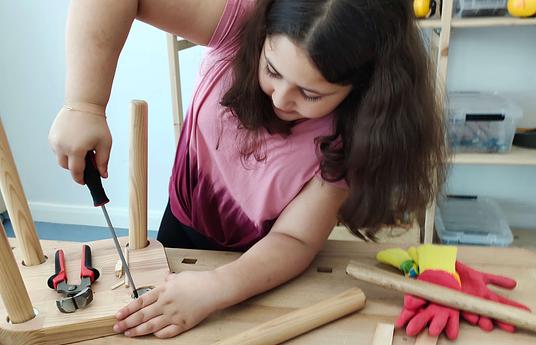
In practice, STEAMathon Qatar operates as a structured, school-based innovation ecosystem. Schools function as innovation hubs where students work in teams to identify real-world challenges and develop practical solutions through hands-on projects.
The model is organized through thematic innovation tracks aligned with national priority sectors such as water, energy, sustainability, and health. Each track brings together schools across primary, preparatory, and secondary levels, enabling collaborative, multi-level innovation.
Students follow a structured project cycle that includes problem identification, ideation, design, prototyping, programming, testing, and refinement. Projects are supported by trained teachers who act as facilitators, along with technical guidance from STEM specialists and engineers.
The process culminates in exhibitions where students present functional prototypes and solutions. These projects often integrate digital tools, sensors, and engineering design, mirroring elements of real-world research and development.
The exhibition also serve as more than a final competition. They create a platform for development, feedback, and connection, bringing students together with experts, partners, and wider audiences who can challenge ideas, offer guidance, identify promising solutions, and open pathways for mentorship, networking, collaboration, and future opportunities.
STEAMathon Qatar has grown from a single-school initiative launched during Qatar Sustainability Week 2020 into a nationally recognized innovation model supported by the Ministry of Education and Higher Education.
The model later scaled to engage over 65 schools, train and involve more than 2,200 teachers, and reach over 45,000 students across Qatar. In 2025, STEAMathon Qatar was recognized as a finalist in the Khalifa Award for Education.
Its reach continued beyond the national edition. In 2025 also, leading student projects were showcased at the Qatar International Agricultural Exhibition (AgriteQ2025), while the STEAMathon Qatar experience was shared internationally through Teach For All programs and initiatives like "Future of Work", "STEAM Community Global Challenges", and "Climate Education Champions". In 2026, its practitioner model was accepted for presentation as a 3Ps session (Policymakers, Politicians, and Practitioners) at the International Congress for School Effectiveness and Improvement (ICSEI) at Qatar University, following independent peer reviews and out of 435 submissions.
The current phase focuses on sustainable scaling through a hub-based model, where selected schools operate as innovation hubs connected to surrounding schools, supported by teacher capacity building, school clustering, and institutional partnerships. This combination positions STEAMathon Qatar for sustainable national scaling and potential international adaptation.
STEAMathon Qatar has evolved significantly from its early school-based sustainability-awareness model into a structured sustainability-innovation model embedded within the education system through STEM HUB framework of Qatar Ministry of Education and Higher Education.
The early phases focused on awareness, curriculum integration, and engagement. As the model expanded, it highlighted the need for deeper learning, continuity, stronger system integration and also wider participation.
In response, the model was redesigned to emphasize structure, quality, and long-term impact. Key modifications include the introduction of innovation hubs within schools, the development of thematic innovation tracks aligned with national priorities, and the implementation of a structured project development cycle.
Additionally, the model now integrates elements of applied research and early-stage innovation, positioning student projects as part of a broader R&D pipeline rather than isolated activities.
STEAMathon Qatar is also under planning to be expanding through complementary pathways such as school-level and university-level programs, creating a continuous innovation journey from early education to higher education and entrepreneurship.
To implement STEAMathon Qatar in a new context, the model can be adapted through a structured, step-by-step approach.
1- Identify key priority themes relevant to the local context, such as sustainability, energy, health, or technology. These themes will serve as the foundation for student projects.
2- Build teacher capacity by providing training in STEM methodologies, project-based learning, and innovation facilitation. Teachers play a central role in guiding students and ensuring effective implementation.
3- Organize participating schools into clusters or networks, enabling collaboration and shared learning. Assign each cluster a thematic focus to structure project development.
4- Guide students through a structured project cycle that includes problem identification, design, prototyping, testing, and presentation. Provide access to basic tools and resources to support hands-on learning.
5- Create opportunities for students to showcase their work through exhibitions or presentations, and ensure follow-up mechanisms to sustain and scale promising projects.
The model is flexible and can be adapted to different education systems while maintaining its core focus on applied learning and real-world problem-solving.