India faces a paradox: while National Education Policy 2020 mandates skill education for every child, nearly 85% of schools lack the infrastructure — labs, equipment, trained trainers — to deliver it. Remote, rural, and under-resourced schools are the worst affected, leaving millions of students with no exposure to hands-on learning, vocational pathways, or the "world of work."
We saw this gap firsthand. Building permanent labs in every school is neither financially viable nor immediate. Yet a child in a small village deserves the same exposure to mechatronics, healthcare, or AI/coding as a child in a metro school. Without it, students continue to perceive vocational education as a "second-best" option, parents remain skeptical, and girls especially are excluded due to mobility, safety, and gendered subject choices.
Skills on Wheels was created to break this barrier. Instead of waiting for infrastructure to reach students, we bring the infrastructure to them. A fully equipped mobile lab on a refurbished truck — with WiFi, audio-visual systems, generator power, and trade-specific machines — travels to schools, communities, and government events.
The innovation also serves a second purpose: advocacy. By demonstrating skill education live to students, teachers, parents, and government officials, SOW shifts perception, drives policy adoption, and catalyzes school-level uptake of permanent skill education programs — operationalizing NEP 2020 from the ground up.
Skills on Wheels is a full-size bus fabricated as mobile multi-skill lab built on a refurbished truck chassis. Two extendable platforms unfold to create open hands-on workstations beside the bus, while inside, mounted machines, an ICT section with computer and sound system, trade-specific tool displays, and storage cabinets transform any school courtyard into a functional skill lab.
Each unit travels on planned routes to schools, villages, and community spaces, staffed by driver, and trained skill trainers.
Delivery is highly experiential, with strong focus on hands-on practice Across trades like Agriculture, Mechatronics, Healthcare, AI/Coding, Basic Engineering, Food Processing, Finance, Fashion, and Automobile.
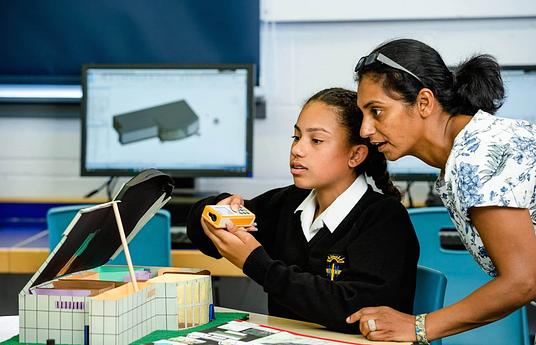
Students operate machines, build small projects, and experience real-world application of theory under expert supervision.
Focus: Problem-solving, teamwork, & real-world application. Content is adapted to age group, local language, and community needs
Tech Support- MIS-based tracking of attendance, participation and feedback
Teachers receive structured briefings on how skill education integrates into the curriculum.
Government Stakeholder Interaction: District officials, parents, and community members engage with the bus, building advocacy from the top down.
In one day, SOW serves 100-120 students under exposure workshops or 50 in deeper trade-specific product-based workshops — turning a single visit into a full-spectrum awareness, training, and advocacy event.
Skills on Wheels has spread organically through a combination of grassroots demand, government partnerships, and high-visibility national platforms.
It began as a single mobile lab in Maharashtra, designed to serve schools with infrastructure limitations. As schools, parents, and officials witnessed the tangible impact — students engaging confidently with tools, girls operating machinery, teachers gaining clarity on NEP 2020 — demand multiplied. Today, SOW has traveled to 19 states and Union Territories, reaching 3.9 lakh+ students and 2.8 lakh+ stakeholders across India.
Key inflection points accelerated the spread:
Pune to Ladakh 2016-17 - 2000+km journey on road across 10 states to spread awareness of skill education
SoW as delivery vehicle - SOW reaches 1 school every week and conducts skill classes
G20 to MoU: SOW's outreach during India's G20 presidency directly led to showcasing innovation at 4 G20 locations
PM SHRI : A partnership with the Ministry of Education for engagement of SoW in PM SHRI trainings, deepening reach into India's flagship school network.
Long-term Partnerships: Multi-year collaborations with state governments and corporate partners (UBS and others) for NEP 2020 operationalisation.
Quality Scale-Up:
SOW now serves as an implementation model for multi-sectoral labs being adopted across states. Build teacher-led continuation models, introduce advanced pathways and future-focused modules such as EV, renewable energy, robotics, and green skills
SoW has evolved continuously, responding to policy shifts, emerging technologies, & field learnings.
Trade Expansion: Originally focused on four core sectors (Basic Engineering, Energy & Environment, Home & Health, Gardening), the curriculum has expanded to 9+ future-aligned trades — adding Mechatronics, AI/Coding, Finance, Fashion, and Automobile.
This responds directly to NEP NCF's emphasis on multiple sectors.
Tech Integration:
Dedicated ICT section with computers and sound systems for online support,
Enabling hybrid delivery — live demos combined with digital content, recorded modules, & virtual expert sessions.
MIS-based systems to track participation, feedback, and implementation data
Size - To reach to deeper areas, the Mini Skills on Wheels model has been developed (on a smaller vehicle) which is Modular (add and remove trades as needed)
Program Design Changes
Early Years - Focus on Mobilisation. Now, mobilisation follows implementation or linkage to school-based delivery.
Accessibility for students with disabilities
Adding gender-intentional programming actively encourages girls into non-traditional trades
Curriculum Modularisation: Two formats have been developed — a 1.5-hour exposure workshop covering 40 students and a full 5-hour trade-specific product-based workshop covering 50 students per day — allowing flexibility based on school context.
Other Stakeholder: Structured orientation tracks for teachers, government officials, and the community
Skills on Wheels welcomes schools, government departments, CSR partners, and community organizations to deploy the mobile lab in their region.
Step 1 — Reach Out: Email skillsonwheels@lendahandindia.org.
Step 2 — Plan Your Deployment: Decide whether you want a single-school visit, a district-wide campaign, an event activation (e.g., Independence Day, conventions), or a multi-school awareness drive. Our team helps design the activity mix — student orientation, hands-on workshops, teacher briefings, or government stakeholder engagement and decide Will Mini SoW work or a Main Bus is needed.
Step 2a — If you want to have your own SoW, You need to buy a Truck or 4-wheel Small Commercial Vehicle (SCV) mini-truck based on requirements. Then It needs to be fabricated and fitted with Tools and Equipment
Step 3 — Provide an open space at the school. Assign one teacher/local coordinator for safety and on-ground coordination.
Step 4 — Financial Commitment: Should cover fuel, maintenance, tools, and consumables, RTO charges, and team accommodation
Step 5 — Day of Deployment: A team of 1 driver, 1 coordinator, and 3 trainers arrives, sets up the bus and platforms, and runs a full day of orientations, demos, and workshops — covering up to 120 students per day along with teachers, parents, and officials.