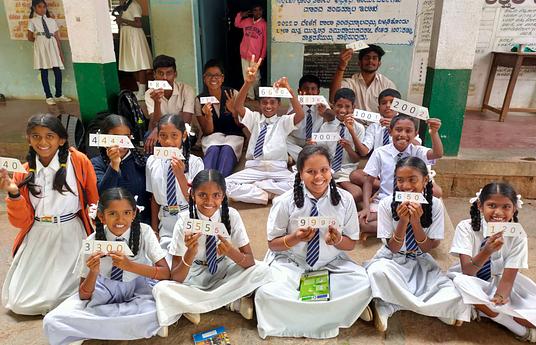
I created the HDI Community Safe Learning Hub after witnessing how unsafe school environments were silently pushing children, especially girls, out of education. Many schools lacked safe reading spaces and psychosocial support. Girls missed classes during menstruation, literacy levels were low, digital access was limited, and stigma around menstrual hygiene and gender-based violence remained unaddressed within families and communities.
I realized that improving learning outcomes required restoring dignity, safety, and opportunity. Attendance cannot improve if students feel unsafe. Literacy cannot grow without access to books. Future readiness cannot develop without digital exposure. Healing cannot occur without trusted spaces for dialogue. Instead of treating these barriers separately, we designed an integrated model that combines a safe reading space (Library), menstrual health support, mentorship, digital skills training, including basic coding, and structured intergenerational dialogue between parents and children, including safe conversations for survivors of gender-based violence.
The Hub serves not only students, but families. It creates protected spaces where difficult topics can be addressed, trust rebuilt, resilience strengthened, and girls equipped with both foundational literacy and 21st century skills. By embedding dignity, wellbeing, digital learning, and community engagement into one ecosystem, the innovation removes structural barriers and transforms
In practice, the HDI Community Safe Learning Hub operates as a fully integrated, community-embedded education space within or alongside the community school within the environs. The space includes a dedicated section for a library stocked with age-appropriate books, and a dedicated mentorship corner for counseling and small-group dialogue. Girls have access to menstrual hygiene supplies and health education, ensuring they can attend school consistently and confidently.
Daily activities include guided reading circles, literacy reinforcement sessions, life-skills workshops, and digital learning classes where girls are introduced to basic computer skills and coding. Teachers receive support to integrate wellbeing and inclusive practices into classroom instruction. The space is also used for structured intergenerational dialogues, bringing parents and children together to discuss education, gender norms, and healing for survivors of gender-based violence in a protected setting.
Our program officer, community volunteers, and trained facilitators manage programming, while attendance and participation are monitored to track improvements in literacy, engagement, and school retention. The space functions as both a learning environment and a safe community anchor, strengthening academic outcomes while restoring dignity, safety, and opportunity for vulnerable children.
The HDI Community Safe Learning Hub has spread through a community-led, partnership-driven expansion model. We began by piloting the integrated WASH and safe learning space approach in underserved schools, working closely with school leaders, teachers, parents, and local authorities. As improvements in attendance, literacy engagement, and girls’ participation became visible, we included more schools.
Expansion has occurred through three main pathways. First, word-of-mouth replication: school administrators and community leaders who observed the model. Second, partnership scaling: we collaborate with local education stakeholders. Third, program layering: in existing schools, we progressively add components such as digital skills training, coding sessions, and intergenerational dialogue programming, deepening impact over time.
The model is designed to be modular and adaptable. Communities can start with an empty classroom as a reading space, then expand to include mentorship, menstrual health support, digital literacy, and gender-responsive dialogue programs. Because local volunteers and educators are trained to manage the space, ownership remains community-based, increasing sustainability.
Our spread is intentional rather than rapid. We prioritize quality implementation, measurable outcomes, and community buy-in before expansion. This careful approach ensures that each new Hub maintains the integrity of the model while adapting to local educational and cultural contexts.
Since launching the HDI Community Safe Learning Hub, we have continuously refined the model based on community feedback and student participation data. Initially focused on WASH access and safe reading spaces, we recognized that infrastructure alone was insufficient to shift long-term educational outcomes. As a result, we expanded the model to include structured mentorship, life-skills programming, and menstrual health education to directly address absenteeism and confidence gaps among girls.
We later integrated digital literacy and introductory coding sessions after identifying limited access to technology as a barrier to future readiness. This addition ensures that girls are not only present in school but also prepared for emerging academic and economic opportunities. We also formalized teacher support components, guiding inclusive practices and psychosocial awareness to strengthen classroom integration.
Another significant modification was incorporating intergenerational dialogue sessions. Community consultations revealed the need for safe conversations between parents and children around gender-based violence. The Hub now functions as a protected space for healing, dialogue, and trust-building alongside academic programming.
These adaptations have transformed the Hub from a facilities-based intervention into a holistic, community-driven education ecosystem that evolves with the needs of the learners it serves.
To try the HDI Community Safe Learning Hub model, begin with a simple community assessment. Engage school leaders, teachers, parents, and students to identify barriers affecting attendance, literacy, safety, and gender inclusion. Map existing infrastructure, available space, water access, and local volunteers who could support implementation.
Start small and modular. Establish a safe reading corner with age-appropriate books and structured reading sessions. Improve basic WASH conditions by ensuring clean, private toilets and reliable water access, prioritizing dignity and safety for girls. Introduce menstrual health education and life-skills workshops to address confidence and retention challenges.
Next, train local facilitators or teachers to lead mentorship circles and monitor participation. If possible, integrate basic digital literacy sessions using shared devices, gradually introducing coding or computer skills. Create regular intergenerational dialogue forums where parents and children can discuss education, wellbeing, and gender norms in a structured, protected setting.
Track simple indicators such as attendance rates, reading participation, and student feedback to measure progress. The key is community ownership: involve local stakeholders in planning, delivery, and oversight to ensure sustainability. The model is adaptable to different contexts and budgets, allowing schools to expand gradually from core elements into a fully integrated safe learning ecosystem.