The education crisis is global, with developing nations being hit the hardest. In Pakistan, 26 million children are out of school and Over 50% of Grade 5 students struggle to read and comprehend a simple text. Traditional education models are too slow to solve the problem, but digital technology coupled with self-learning and gamification provide a cost effective and scalable solution.
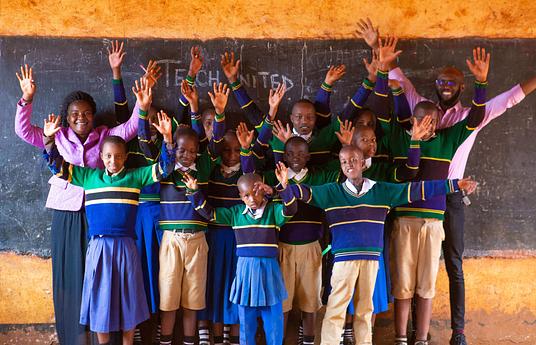
Teach the World’s Digital MicroSchools model is a simple and scalable “functional literacy” solution for students in Pre K to Grade 2. It has been deployed with excellent results in Pakistan, Bangladesh, and Malawi, in varied settings, from urban slums to refugee camps and remote Himalayan villages.
Our students outperform students in traditional schools, achieving at least 1.5 times the learning gains, as measured by independent third parties across time, multiple geographies, and environments.
We partner with best-in-class award-winning content providers and deploy their content on tablets and smartphones. The model does not require reliance on a trained teacher. The model delivers world-class reading, writing, and math applications in a gamified format, on low-cost tablets and smartphones. Children learn math, English and their local language in a gamified format for 2 hours a day/6 days a week in a facilitated setting within existing schools or in community-based learning centers powered by solar technology.
Over the last 3 years, Teach the World has scaled to 20,000 learners in 3 countries, with validated impact evaluations showing students outperform traditional models by 2.5x. Teach the World has also received global recognition, winning the World Bank’s Ideas4Action competition, featured by UNESCO among the best COVID-response interventions in 2021, and the HundrED Global Collection 2026. Teach the World was a finalist in the MIT Solve Global Challenge in 2022 and finalists for MIT Solve Tiger Challenge for Bangladesh in 2019, which we presented in Dhaka. Teach the World was among the winners of the 2023 MIT LEAP Challenge. Teach the World are also 2026 finalists for the FM Kirby Prize for Scaling Impact.
We have partnered with the Government of Sindh in Pakistan to scale to establish 200 new Digital MicroSchools which will serve almost 20,000 more students in Pakistan. Till 2030, we aim to scale to 200,000 learners globally by partnering with local governments for policy integration and implementation. We will create lasting social impact by:
Accelerating access to education
Enhancing socio-economic well-being
Empowering girls, women and communities
Teach the World's Digital MicroSchools model has been further tested at scale through partnership with the local government. We have set up a dedicated field structure including Community Officers, Technical Officers, Monitoring & Evaluation Officers as well as Area Managers to support the digital learning facilitators. Area offices have been established and embedded directly within beneficiary communities.
We began with a single MicroSchool serving 25 children. From there, we refined the model, validated outcomes across diverse geographies, from Himalayan villages to refugee camps, and built government receptivity through evidence-backed pilots. We’re now at a critical inflection point: our three-year, 100-school pilot with the Government of Sindh has shown strong outcomes, backed by an independent midline evaluation. The province has greenlit the next phase: sustaining the first 100 schools and expanding to 200 more, reaching 30,000 out-of-school children every budget cycle.
As part of recent program improvements, we’ve adopted a stronger community-driven design approach. Over 3,000 community members are now engaged annually through surveys, focus groups, and workshops. Regular feedback from parents, facilitators, and local leaders directly informs curriculum and operations, ensuring alignment with local values and needs. All new initiatives are piloted and refined within communities before scaling, making the program more responsive, inclusive, and impactful.
Teach the World created The Digital MicroSchools model with the intention of replication across the developing world. We use off-the-shelf hardware to deploy content from internationally recognized providers. We can provide training and strategic oversight for deployment of the model. Organizations interested in partnering with us can contact our Vice President Adnan Ahmed at adnan.ahmed@teachtheworld.org.