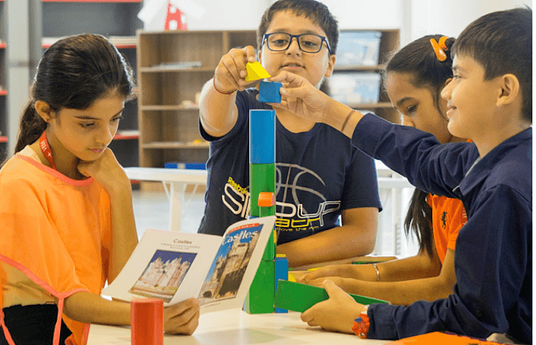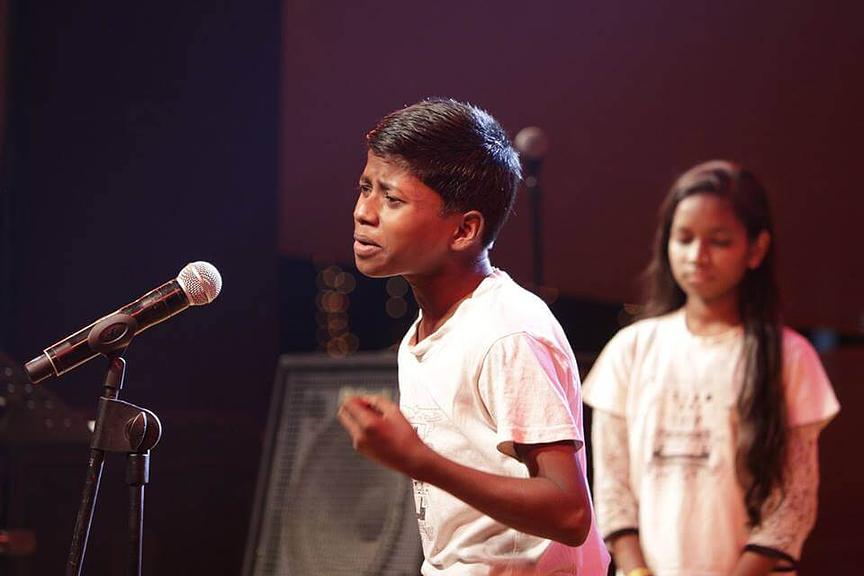
The capacities children need most are built when they create, perform, question, and discover.
Global research shows that the visual and performing arts are among the most natural ways to nurture these skills. Yet, in our schools, the arts remain deeply deprioritized.
- Children get less than 20 hours of arts learning a year in India
- An average art teacher–student ratio is 1:1400.
Slam Out Loud reimagines learning through the arts, so children in government and low-income private schools across India can flourish today and be ready for tomorrow.
Children, especially those from adversity, need the readiness to navigate uncertainty, recover from setbacks, build relationships, make decisions, and imagine larger futures for themselves.
At Slam Out Loud, we focus on strengthening five interconnected foundations:
- Identity: “I believe in my own ability.”
- Aspiration: “I belong in bigger rooms. My circumstances don’t define my ceiling.”
- Self-efficacy: “I can influence what happens to me.”
- Resilience: “When life gets hard, I know how to come back.”
What we do
We ensure children in government schools get access to the arts and transform the art class into a space for growth and learning. Through poetry, theatre, storytelling, movement, and visual art, children develop future facing skills.
How we do it
We build and test arts-based learning in classrooms with trained art educators, learning directly from children, teachers and schools. We then partner with state governments to embed what works into curriculum, training, pedagogy and measurement, and enable government school teachers to deliver it at scale.
In SOL classrooms, children write, perform, draw, move, reflect and create together. Social-Emotional Learning (SEL) allows them to find spaces within the education system where they:
- Make sense of complexity
- Imagine new realities
- Understand their emotions
- Think critically, and
- Take initiative
Through state partnerships in states such as Punjab, Maharashtra and Bihar, Arts for All works with public education systems to make the art class a regular part of a child’s school week. We partner with departments to strengthen policy, curriculum, teacher training and system resources, so arts learning is not optional or occasional, but delivered by government school teachers at scale.
Across Delhi, Bengaluru, Mumbai, and Pune, the Jijivisha Fellowship places trained art educators inside schools and communities. Fellows work closely with children, teachers, parents, and local contexts to design powerful art experiences that build identity, aspiration, resilience, and agency.
Directly enabling students with SEL skills in government and low-income private schools across India
700,000+ Students directly enabled with SEL skills across government and low-income private schools in India
5 States across India
20M Children reached through digital resources
38% Average growth in Future Readiness Skills
Measured via competency-based assessments, not self-report (*24-25 TJF program)
90.5 Average Student NPS: children rating their SOL experience
(*24-25 TJF program)
80% of teachers report a reduction in classroom disruption due to behaviour issues
(*24-25 Arts for All Abhivyakti program)
81% of teachers report an increase in instructional time within classrooms
(*24-25 Arts for All Abhivyakti program)
Our open source curriculum is accessible on our website. Additionally you can write to contact@slamoutloud.org to discuss collaborations or possibilities of executing arts based SEL in your own context.


.jpg)