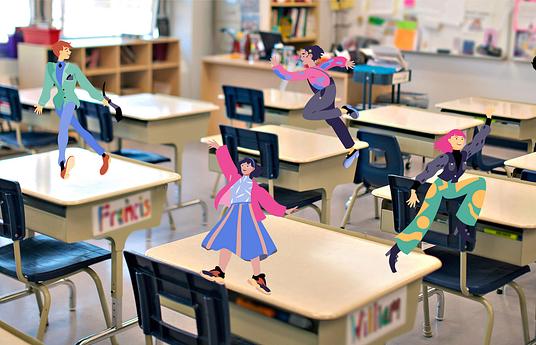
Sometimes students arrive at lessons feeling restless and overstimulated—being in a state of hyperarousal. At other times, they may be under-aroused during the lesson and unable to concentrate. To address this, we co-designed, based on research and in collaboration with students and teachers, a variety of XR emotional landscapes featuring moving images and soundscapes that influence focus, arousal levels, and stress. These environments help optimize students’ alertness to a suitable level. The user interface is simple, and the system allows teachers to create brain-refreshing breaks during lessons or activate focus-enhancing emotional landscapes to support learning. Traditional classrooms lack adaptability to students' emotional and cognitive states, often negatively affecting concentration and motivation. We designed XR Classroom to dynamically adjust emotional atmospheres, improving students' focus, emotional well-being, and academic engagement through immersive, responsive learning environments. The system also includes an AI-powered learning analytics tool that provides teachers with real-time insights into students’ academic emotions, well-being, learning progress, and concentration—if they choose to use it. Our research shows that students value when the teacher is interested in their emotional state during the lesson and, if necessary, responds by adjusting the lesson plan when the classroom emotional climate is negative.
XR Classroom integrates Extended Reality (XR), projection mapping, and Dolby Atmos technology to create tailored emotional landscapes (e.g., forests, lakes, calming music) based on students' feedback collected via a real-time emotional analytics tool ("Fiilismittari"). AI adapts classroom environments dynamically, enhancing students’ emotional states and concentration.
Evidence from co-designed student workshops indicates improved motivation, reduced stress, and better concentration when XR environments matched student preferences. Over 300 students identified natural landscapes and instrumental music as highly beneficial to their emotional and cognitive states. Research shows XR environments significantly boost learning, well-being, and focus, especially when environments reflect students' own emotional needs.
Since its establishment at the University of Jyväskylä Teacher Training School in 2023, XR Classroom has been successfully piloted, receiving strong positive feedback from over 300 students and teachers. It has proven effective in improving classroom engagement, concentration, and emotional well-being.
In the next two years, our goal is to expand the use of XR Classroom across multiple Finnish schools, further refine the AI-driven analytics system, and establish research-backed best practices. We aim to publish research findings on emotional landscapes' impact on learning outcomes and student wellness. The XR Classroom has been actively presented and promoted since 2022 through national and international events, including conferences such as ITK, EDUCA, and BETT in London. It has been showcased in research symposia, teacher training days, and study visits, reaching educators, researchers, and policymakers. The innovation has gained visibility through both public events and expert forums, with growing international interest. We have also written and published a research article on the co-design process of the XR Classroom and the experiences of students and teachers using it.
In summer 2025, we will add touch screen functionality to the displays and enable the creation of subject-specific content on the classroom walls for any subject. We have equipped XR Classroom for learning research purposes, based on the provided equipment list:
The XR Classroom is equipped with a wide range of technologies that enable the collection of both physiological and contextual data to study learning processes in depth. Researchers can gather:
- Physiological stress and response data using 40 Firstbeat BG3 sensors.
- Long-term physical well-being indicators via 20 Garmin Forerunner 955-smartwatches and 5 Apple Watch Series 9 devices.
- Balance and motor control data from 6 AinI balance sensors.
- Brain activity data (EEG) through 15 Emotiv EEG headsets.
- Student movement and physical activity using the UuGo indoor positioning system and 18 movement sensors.
- Environmental data including temperature, humidity, light levels, sound levels, CO₂/O₂ concentration, and VOC levels, measured by Dracel sensors.
- Video data of learning situations recorded by a 360 HD camera.
- Survey-based student feedback collected in real time with 20 research iPads equipped with the Fiilismittari tool. This tool measures students’ concentration, alertness, overall mood, and learning experience. Data is exportable in CSV/Excel format with time stamps, enabling researchers to compare subjective feedback with physiological responses and evaluate how different teaching methods influence.
Interested schools should contact the XR Classroom team at the University of Jyväskylä Teacher Training School. We provide implementation guidelines, co-design workshops for student involvement, and training for teachers. Initial consultations can be arranged through our website or by directly contacting our project lead, Dr. Hannu Moilanen (hannu.moilanen@jyu.fi).