%20(1).jpg)
Children in underserved communities often grow up without safe spaces to express themselves or build confidence. Schools focus on academic growth, leaving limited room for communication, teamwork, and social emotional development. When learning feels stressful and disconnected from real life, early school dropout becomes common.
Youth face peer pressure and sometimes involvement in crime, not because they want to, but because they lack positive support. Girls are often restricted from public play, limiting mobility, voice, and leadership.
We saw that Ultimate Frisbee naturally teaches these skills. It is self refereed, so players must talk, listen, and resolve disagreements respectfully. Its mixed gender nature helps inclusion and shared responsibility from a young age. On the field, children practice communication, empathy, and confidence in real situations. This builds systemic agency in the participant to have a bias for action and not expect another person to dictate what they can do.
We informally started with 15 children in the village of Zamrudpur. The changes we saw in these kids inspired us to take it to more children and young people. We created this innovation to give children spaces where they feel safe and valued, where learnings happen through play, and where youth from their own communities grow as role models. Children deserve more than survival. They deserve places to build confidence, responsibility, and become capable citizens who shape their own futures.
Our innovation is a community and school based Ultimate Frisbee program for children and youth aged 9 to 18. Sessions happen 2-3 times a week on school fields or public grounds in Delhi NCR, India. Trained youth coaches from similar communities create a safe space to play, express, model respect, and guide learning through reflection.
A session begins with a check in followed by warm-up and drills. Children then play in mixed gender teams. With no referees, players learn to call fouls, explain decisions, listen, and restart play together while coaches support responsibility and fairness.
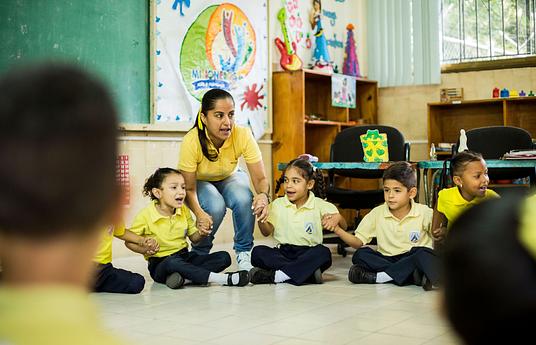
Every session ends with a reflective spirit circle. As the sport is self refereed, the spirit circle is the foundation that protects and enables the culture of self regulation to be the norm. Coaches ask what helped the team or how a disagreement was solved, helping children connect choices on the field to everyday life.
After regular sessions in a school or community, we organise tournaments to put these learnings to test. This becomes an avenue for participants to practice integrity, respectful communication and conflict resolution when stakes are high and each point decides the outcome of the game. After repeated practice and playing opportunities, the peer leaders from each program are mentored to step up as coaches for the next generation of children. This enables youth to further their own leadership skills while paying it forward and earning a stipend to sustain their aspirations.
Our innovation has grown through community demand, youth leadership, and partnerships. We began with around 15 children in one community, where children invited their friends and siblings. As parents and teachers noticed improvements in confidence, discipline, and communication, participation grew. Today, we have reached over 2500 children across Delhi NCR.
Youth coaches have become our strongest ambassadors. When they describe what they do on the field, other schools and communities want to adopt the program. Many new groups began because someone saw a session or heard about it from children.
Partnerships with schools have played a major role in our scale up. Schools that want sports based life skills sessions have invited us to run the program during school hours, integrating it with their weekly timetable. This ensures high attendance, regular practice, and support from teachers.
Community tournaments bring children from different schools and neighbourhoods to play in mixed gender teams. School staff and parents see self refereeing and youth leadership in action, which builds trust and leads to expansion into new schools.
We also deliver short demonstrations and workshops in new regions to introduce our approach and understand local context. Growth has been steady and focused on sustainability, so each new site has trained youth coaches, safe spaces, and school support to make the learning meaningful.
Our innovation has evolved as we listened to children, youth coaches, and families. In the beginning, we focused mainly on teaching the sport and creating a safe space to play. Over time, we realised that the most powerful learning came from the conversations around the game, so we made guided reflection a stronger part of every session.
We adopted Dream a Dreams Life Skills Assessment Scale to track changes in behaviours like interacting with others, taking initiative, and managing conflict. This helped us understand what children were learning and where we needed to adapt our approach.
We put more attention on girls participation and safety. We increased women coaches, spoke more with parents, made mixed gender play more intentional, and chose timings and locations that help girls attend regularly.
Youth leadership has become a clearer pathway. Older players now take on roles as junior leaders, assistant coaches, and eventually lead coaches. We support them with regular training, mentorship, and responsibilities that build confidence and facilitation skills.
We also strengthened parent and community engagement through meetings and showcases so families understand why play based learning matters. We have developed training resources, session plans, and simple curriculum tools so our model can be shared more easily with partners. The innovation continues to grow as we learn from every new group of children and coaches.
We believe that it shouldn’t be just Y-Ultimate that carries out this work and we believe in the spirit of collaboration and teamwork to enable more children to have access to a space to help them grow. As every community and school’s need could be different, we are happy to connect and support them. Those who are interested can reach out to us at connect@yultimate.org
There are multiple ways we can enable and support others through knowledge sharing, program design consultation, coach & facilitator training, curriculum development, continuous mentoring and much more.