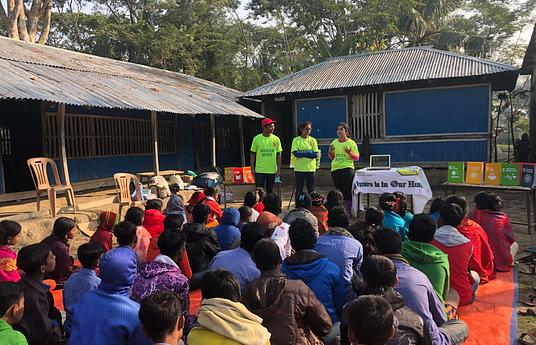
We first met children from a slum community when we ran arts and sports activities. They impressed us as smart, articulate, and fun but delving deeper into how they did in school, many were failing and most had grades just hitting the minimum passing mark. We talked to their mothers reminding them that better grades were required to pass high school but that seemed to be a problem for another day. It was not that the women were uncaring. They simply did not think there was much they could do. We were reminded of the April 2025 report of a government commission that 18 million Filipinos could be functionally illiterate, or have problems in comprehension, To fill this gap, we determined that the best way to help then children was to provide tutorials in reading as most were slow and struggling readers. Writing was also a skill they needed help with, as part of their failure to keep up with school work was their inability to write notes and copy assignments from the board. Our centers were the first to serve children from the lowest income class and give free tutorials. We saw reading and writing as skills that with some guidance and a lot of practice time could quickly be acquired. This proved right when children started becoming fluent readers in 3-6 months and those who did began volunteering to help tutor the other children. So was born our peer tutoring program. It stemmed from the children's need to give back and create community.
We maintain a physical presence in each of our locations for children to know they have a regular place to go to. Each center has a library and a pantry since we provide a meal or a snack for the children who come to us as most are undernourished, a situation highlighted in the final report of a legislative commission on education which found that 23.6% of children are stunted, impairing their cognitive development with 42% among the poorest chronically undernourished. Beyond providing meals, we address the deficit in early intellectual stimulation by encouraging children to be readers in bi-monthly read-alouds we organize for younger children in the community. This matches a newly fluent reader with 4-6 year olds who are read to and with whom a conversation is started on the characters, content, and impact of the stories read. This stimulates the minds and imaginations of those read to and serves to build up the profile of child-readers in the community and strengthens their connection with it and with UHF. That link keeps children returning to UHF as peer tutors, creating a virtuous cycle that has a stable number of UHF children volunteering regularly as peer tutors.
We started with one learning center in 2000 and now have 5 centers. Two are in the National Capital Region while three are in Pampanga Province. Except where our head office is also located, all our centers are in spaces lent to us by the public school or the local government unit. Without such support, the centers' set-up cost would have been prohibitive. Word of what we do has also spread through the children. 4K, our organization of peer tutors, promotes our tutorials, identifying communities where children need help. Although we have not built new permanent centers, we have partnered with schools and local government units on short-term tutorial programs. We see this as multiplying over the course of the next two years.
We have become more participative in managing and developing programs. Children are already very much involved in maintaining our peer tutorial program. Peer tutors meet regularly to discuss the progress of children under their care and to exchange notes on best practices. The trust that has developed over time has encouraged us to include them in our planning cycle.
Email us at uhf@unanghakbang.org.