I created KODOMO EHON to help children develop the power to shape their own stories—not only in books, but in their lives.
Through creating picture books, children learn to imagine, express, and take ownership of their thoughts and emotions. This ability becomes a source of strength, helping them face challenges and live meaningful lives.
Since 2016, I have worked with kindergartens and preschools in Japan, engaging over 7,000 children across Japan and Asia.
In one session, I noticed a worn-out cardboard robot in a classroom. A teacher said it might soon be thrown away. A child quietly said, “This robot is very strong. It’s my friend.”
In that moment, I realized children see meaning where adults often do not. Kodomo Ehon creates space for those unseen stories to emerge.
Even shy children gain confidence and discover the value of their voice through storytelling and drawing.
As the world changes, one essential ability remains: the capacity to overcome adversity. I believe the power to create one’s own story—even in difficult situations—is something children can develop through this process.
KODOMO EHON is not only about making books. It nurtures inner strength and helps children realize that their story has value.
In practice, KODOMO EHON begins with conversation—not instructions. A facilitator sits with a small group of children and asks open-ended questions to spark their imagination, such as: “Once upon a time… who was there?” or “What kind of trouble did they face?”
Through this dialogue, children offer unexpected and original ideas. The facilitator listens carefully and gently guides the flow, allowing a complete story to emerge naturally from the children’s words. In this process, children are the authors, and the facilitator supports rather than directs.
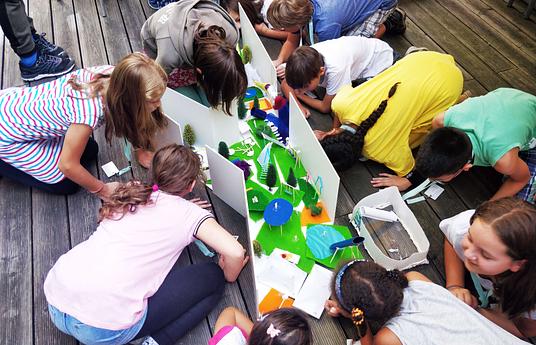
Once the story is created, children freely illustrate their ideas. There are no fixed rules or templates, allowing each child to express their unique perspective.
The story and illustrations are then combined into a finished picture book—one that could only be created by those children, at that moment, in that place.
This process is simple and adaptable, requiring minimal resources while fostering creativity, confidence, and emotional expression. Through dialogue and play, children experience that their ideas have value, and that their voice can take shape in the world.
Since 2016, KODOMO EHON has spread organically across Japan and parts of Asia. It began with visits to local kindergartens and preschools, where children co-created picture books. After each project, teachers and parents shared the experience within their networks, leading to new invitations from different schools and regions.
This word-of-mouth growth has been central to the spread of KODOMO EHON. Rather than relying on large-scale promotion, the focus has been on building trust, meaningful relationships, and strong impact in each location. As a result, more than 7,000 children have participated.
In 2025, we introduced a new model called the “Ehon Baton,” a relay-style approach in which one school introduces the next. This model is helping expand the initiative into new regions, including rural communities with fewer opportunities for creative expression.
To support scalability, we also work with educators and facilitators, providing guidance so they can implement the process independently. This enables the model to continue and grow beyond direct involvement.
Looking ahead, we are preparing for global expansion by documenting the methodology, translating materials, and engaging with international platforms such as HundrED. Our goal is to enable children across cultures to connect through storytelling, using stories as a bridge for understanding.
Since launching KODOMO EHON in 2016, we have continuously refined the approach based on feedback from children, educators, and communities.
One key development is the “Ehon Baton” model, introduced in 2025. This relay-style system allows each school to introduce the next, creating a sustainable, community-driven expansion. It also fosters connections between children in different regions through shared stories.
To support scalability, we began working with educators and facilitators so they can implement the model independently. This enables the innovation to grow beyond direct involvement while maintaining quality and local ownership.
We have also made the process more inclusive. For children who find it difficult to express themselves verbally, we introduced visual and play-based approaches such as drawing-led storytelling and physical prompts.
In addition, session formats are flexible. Some programs are completed in one day, while others take place over several weeks, depending on the context.
We are also preparing for global expansion by documenting the methodology and translating materials.
KODOMO EHON continues to evolve, shaped by the children and communities it serves.
KODOMO EHON is designed to be simple and adaptable. Anyone—a teacher, parent, or community member—can begin with basic materials such as paper and pencils.
To get started, we recommend a simple process:
Sit with a child or a small group of children.
Ask open-ended questions to spark a story, such as:
“Once upon a time… who was there?”
“What were they doing?”
“What problem did they face?”
Let the children build the story through dialogue.
Invite them to draw scenes from their story.
Combine the story and drawings into a handmade book.
No professional teaching experience is required. The key is to listen, follow the children’s imagination, and create a safe and supportive space for expression.
To support wider adoption, we are developing simple guides, example materials, and translations for global use. These resources will be available on our website.
We also welcome educators and communities who are interested in implementing KODOMO EHON or becoming facilitators. We provide guidance, collaboration, and support to help them start and continue the process independently.