Climate change is increasingly affecting vulnerable communities, yet school education often treats it as theoretical content rather than practical action. In many schools in Pakistan, environmental topics are taught without structured opportunities for students to apply knowledge or measure real-world impact.
This gap inspired the creation of the Green School Climate Action Program, a structured model that connects climate education with hands-on student-led action. The goal is to shift environmental learning from awareness-only approaches toward measurable behavior change and youth leadership.
The innovation was designed to help schools develop not only environmental knowledge, but also responsibility, problem-solving skills, and long-term climate awareness through real participation in sustainability activities.
The program runs inside schools as a structured cycle of learning and action.
First, students participate in weekly climate education sessions covering topics such as climate change basics, waste management, water conservation, and biodiversity. These sessions are interactive and discussion-based rather than lecture-heavy.
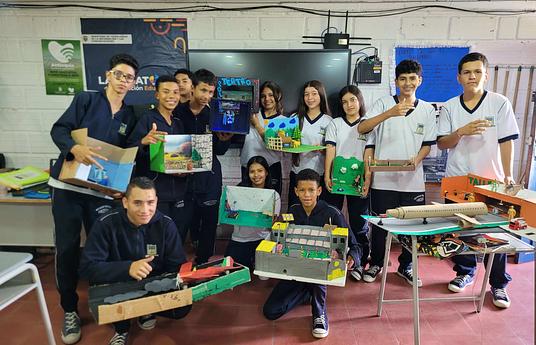
Second, students form small groups and implement action projects within their school, such as waste reduction campaigns, tree plantation drives, or water-saving initiatives. Teachers guide but students lead the process.
Third, each school tracks simple impact indicators such as number of students involved, participation levels, and visible environmental changes (e.g., waste reduction efforts, number of trees planted, or cleanliness improvements).
This creates a continuous cycle: learn → act → measure → improve. The program is designed to be low-cost and adaptable for both rural and urban schools.
The innovation is currently being implemented in a small number of schools in Khyber Pakhtunkhwa, Pakistan through direct engagement and school-level coordination.
It spreads mainly through student-led sessions, teacher collaboration, and word-of-mouth interest from schools that observe activities in neighboring institutions. Schools that participate often replicate selected activities such as awareness drives or plantation campaigns.
At this stage, the model is in early expansion, focusing on refining structure, improving documentation, and standardizing tools (lesson plans, activity guides, and tracking sheets) to enable wider adoption.
The long-term goal is to develop it into a transferable school toolkit that can be adopted independently by other schools without direct supervision.
The innovation has evolved from informal awareness sessions into a structured program model.
Initially, activities focused mainly on environmental awareness talks in schools. Over time, the approach was improved by adding structured learning modules and student-led action projects to increase engagement.
A simple impact tracking system was also introduced to measure participation and outcomes more systematically instead of relying on observation alone.
Currently, efforts are being made to standardize the program into a repeatable toolkit that includes session outlines, activity guides, and basic reporting templates. This improvement is aimed at increasing scalability and ensuring consistency across different schools.
To implement the Green School Climate Action Program, start by identifying a school and selecting a group of interested students and a supporting teacher.
Begin with short weekly sessions introducing climate change and environmental issues in a simple, discussion-based format. After foundational learning, divide students into small groups and assign practical school-based environmental projects such as waste reduction, cleanliness improvement, or tree planting.
Provide basic guidance but allow students to lead planning and execution. Encourage them to document their activities using photos, simple reports, or checklists.
At the end of each cycle, collect feedback and measure outcomes such as participation levels and visible environmental improvements. Schools can then repeat the cycle with new student groups.
The program is designed to be flexible, requiring minimal resources and adapting easily to local school conditions.