Future Problem Solving (FPS) was created to address a critical gap in education: students are often taught about complex challenges, but not how to solve them. In 1974, our founder, Dr. E. Paul Torrance, helped catalyze a movement toward creative teaching and learning by developing a research-based 6-step problem-solving process that remains at the core of our work today.
While many educational models build awareness of global and local issues, few provide a structured pathway for students to apply their learning through real-world action. FPS Community Projects was created to close that gap, moving beyond analysis to implementation. Students identify authentic community needs, develop solutions, and carry them through to action.
This approach builds agency, helping young people move from concern about the future to ownership of it. By connecting research, decision making, and implementation, FPS Community Projects transforms learning into measurable impact and prepares students to address complex, interconnected challenges, including those related to planetary health.
FPS Community Projects extends problem solving from analysis to real-world action. Students identify an authentic area of concern within a chosen community and conduct sustained research to understand root causes, stakeholders, and context.
They generate and evaluate solution ideas, select a strategic course of action, and implement their plan in collaboration with community partners. As they adapt to challenges and document outcomes, students apply critical and creative thinking in dynamic, real-world settings.
The work is captured through a project proposal, a project report detailing implementation and impact, and supporting materials that demonstrate evidence and reflection. Throughout the process, students build systems thinking, collaboration, communication, and leadership skills while applying learning across disciplines.
Learning is reinforced through rubric-based, authentic assessment. Students receive structured feedback from trained evaluators at each stage, ensuring academic rigor while strengthening their ability to translate ideas into effective action.
Impact is measurable and meaningful. A Social Return on Investment (SROI) evaluation conducted by the Project Management Institute, with Social Value International, found that student projects generated $4.9 million in collective social value in 2024. Nearly 80% of that value reflects gains in student skills and attributes, demonstrating that the FPS delivers real-world impact and lasting learning outcomes.
Participation grew by more than 30% last year and is on track to grow significantly again, reflecting increased demand and accelerating efforts to expand access to more schools and youth worldwide. Educators report increased student engagement, deeper connections to community, and stronger interdisciplinary learning, along with more meaningful integration of service-learning into classroom instruction.
A major recent achievement is our collaboration with the Project Management Institute Educational Foundation (PMIEF). Together, we developed A Guide to Project Management Implementation, a free resource that introduces students to foundational project management concepts, tools, and templates to support effective implementation. PMIEF also supported a Social Return on Investment (SROI) study demonstrating a $1:$33 social impact, strengthening evidence of both learning and community outcomes.
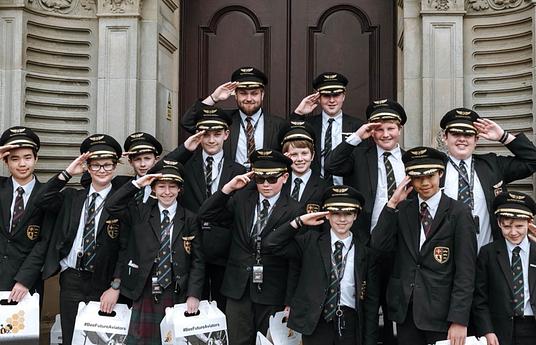
Another defining strength is student collaboration with local stakeholders. Teams research community needs, interview experts, partner with nonprofits, and engage local leaders. For example, a student-led “Bee Aware” initiative partnered with Beechworth Honey and the WheenBee Foundation to promote pollinator health, advancing environmental well-being through real-world action.
Looking ahead, we will continue expanding access, strengthening partnerships, and enhancing resources to support more students in translating ideas into meaningful impact.
Future Problem Solving Community Projects continues to evolve to improve access, usability, and impact for students and educators. A key recent enhancement is the development of A Guide to Project Management Implementation in collaboration with the Project Management Institute Educational Foundation (PMIEF). This resource strengthens the connection between problem solving and real-world execution by introducing practical tools, techniques, and frameworks.
We are now expanding this content beyond a single, downloadable format into more flexible, modular resources. These new resources include tool-specific learning units, editable worksheets, and content delivery across a variety of digital platforms making it easier for educators and students to use the materials in a variety of settings.
Enhancements also include the integration of real-world student examples, testimonials, and video to better engage youth and demonstrate the tools in action. Together, these updates support both big-picture project design and step-by-step implementation, helping more students translate ideas into measurable, real-world impact.
FPS Community Projects works in and beyond the classroom, in all the spaces and places youth do service learning. Participation options include schools, community-based clubs, after-school enrichment, youth development programs, independent learning channels, and at-home participation with a parent as coach/sponsor. Visit our website to find a local affiliate or contact us to explore.