Beyond Books is a community-driven early learning innovation that uses indigenous storytelling, folk songs, traditional games, local languages and play-based activities to help children develop foundational literacy and other essential learning skills. It connects what children learn at home and in their communities with what they experience in the classroom, making learning more meaningful, enjoyable and culturally relevant.
I created this innovation after witnessing how many children in underserved communities struggle with reading and foundational learning. As a teacher and reading intervention specialist, I saw children who found conventional approaches to learning challenging, yet could confidently tell stories, sing folk songs, participate in traditional games and share knowledge drawn from their everyday experiences. This made me realise that our children’s cultural heritage and community knowledge could be powerful tools for improving learning outcomes.
I wanted to create an approach that recognises the strengths children already possess rather than focusing only on what they cannot do. Through storytelling circles, literacy clubs, play-based learning and community participation, we create opportunities for children to learn through familiar experiences while building their reading skills, confidence, creativity and love for learning.
Beyond Books brings learning to life by transforming children’s everyday experiences, cultural heritage and community knowledge into practical learning opportunities.
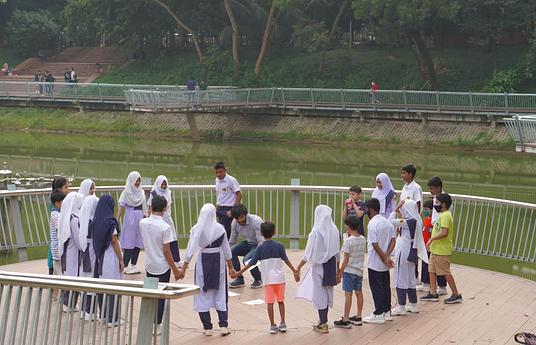
In practice, we organise Literacy Clubs, Storytelling Circles and Play-Based Learning Sessions where children learn through indigenous folktales, folk songs, traditional games, local languages, role-play and creative activities. For example, a traditional story becomes an opportunity for children to practise listening, learn new vocabulary, retell events, develop comprehension and build confidence in expressing themselves. Traditional games and songs help reinforce language, memory, sequencing and social interaction.
We also engage parents, teachers and community members in supporting children’s learning beyond the classroom. By incorporating familiar cultural resources into learning activities, we make foundational education more accessible, engaging and relevant to children’s lives, particularly in underserved communities.
Our approach is flexible and community-centred, allowing activities to be adapted to children’s ages, abilities and learning needs. We pay particular attention to children who struggle with reading, creating supportive environments where they can practise essential skills at their own pace without fear of failure.
Ultimately, Beyond Books demonstrates that learning can happen everywhere. By connecting culture, play and literacy, we help children build foundational skills.
Beyond Books has been spreading through community engagement, school partnerships, teacher collaboration and advocacy for culturally responsive, play-based learning. Our work builds on the experience of The Reading Clinic Initiative, which evolved into Beyond Books Ghana as our vision expanded beyond reading interventions to embrace broader learning opportunities for children.
We have engaged children in underserved communities through literacy interventions, storytelling activities and school-based programmes, including activities in schools across the Sagnarigu Municipality in Northern Ghana. By incorporating indigenous stories, folk songs, traditional games and familiar cultural experiences, we demonstrate to teachers, parents and community members how everyday resources can become powerful learning tools.
Our approach also spreads through community events, professional networks, educational forums and digital platforms, where we share experiences and promote the importance of culturally relevant early learning. Through these connections, we encourage educators and community members to adapt our methods to their own contexts.
Beyond Books has evolved from a primary focus on reading recovery and remediation into a broader, more holistic approach to early learning. Initially, our work focused on helping children who struggled with reading to develop essential literacy skills. However, our experiences working with children in underserved communities showed us that children learn in different ways and that meaningful learning must extend beyond reading alone.
We have therefore expanded our approach to incorporate indigenous storytelling, traditional games, folk songs, creative play and local languages as practical tools for developing foundational skills. We have also broadened our programmes to include Literacy Clubs, Storytelling Circles, Play-Based Learning Sessions, Parent Learning Sessions and Community Learning Activities.
Another important development has been our growing emphasis on community participation. We recognise that parents, teachers, elders and other community members possess valuable knowledge and resources that can enrich children’s learning. Our approach increasingly draws on these strengths to create learning experiences that are culturally relevant, engaging and accessible.
These modifications reflect our commitment to responding to children’s needs and building on the strengths of their communities. Rather than relying solely on conventional teaching methods, we continue to explore ways of making learning more inclusive, enjoyable and connected to children’s everyday lives.
Getting started with Beyond Books is simple. You do not need expensive teaching materials; you can begin with the stories, songs, games and cultural knowledge already available in your community.
1. Know your learners: Identify the children’s ages, learning needs, language backgrounds and existing literacy skills.
2. Use familiar stories: Invite an elder, parent or teacher to share a local folktale. Encourage children to retell the story, identify characters, learn new words and express their ideas.
3. Introduce learning through play: Use traditional games, folk songs, role-play and storytelling activities to develop listening, speaking, vocabulary, comprehension and early reading skills.
4. Create regular learning sessions: Establish a small Literacy Club or Storytelling Circle in a school, community centre or other child-friendly space.
5. Involve parents and community members: Encourage families, teachers and elders to contribute stories, songs, games and other cultural resources that support children’s learning.
6. Observe progress: Monitor children’s participation, confidence, vocabulary and literacy development to identify what works and where additional support is needed.
7. Share and improve: Reflect on each session, gather feedback from children and caregivers, and adapt activities to meet learners’ needs.