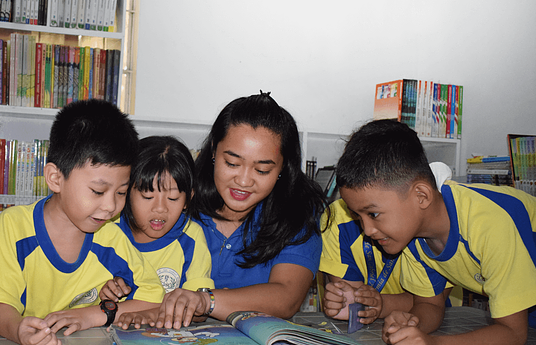
I created this innovation because 1st-grade students face immense learning anxiety when trying to grasp abstract letter proportions through traditional methods. Observing their struggles with handwriting inspired me to merge physical 3D origami with AI. This provides children with a low-cost, multi-sensory, and stress-free way to self-correct, boosting both their writing precision and reading confidence
In practice, the student writes a letter in their notebook, and the teacher captures a photo of it. The AI instantly analyzes the handwriting grid and spatial proportions, displaying a green checkmark or a red X. Simultaneously, a digital simulation of a physical 3D origami paper model appears on screen: it stands upright if the handwriting is correct, or collapses if the proportions are wrong. This phygital combination allows young learners to engage in multi-sensory, stress-free self-correction by linking geometry, tactile models, and vocal phonics sounds.
The innovation has started spreading locally through direct classroom implementation in my school, where it has shown significant positive feedback in reducing students' handwriting anxiety. Moving forward, the project is designed for rapid and wide global scaling by utilizing free, easily accessible AI software and simple, low-cost printable 3D paper models. This ensures that any primary educator, parent, or educational institution around the world can download, access, and implement the methodology without financial barriers.
I have enhanced the innovation by shifting it from a purely digital screen application into a highly integrated 'phygital' methodology. By adding physical 3D paper models alongside the AI feedback, the system now provides a tactile and concrete experience that bridges the physical act of writing with instant digital recognition. This addition ensures complete sensory reinforcement (tactile, visual, and auditory) to fully support young learners suffering from writing anxieties.
To try this innovation, you only need a standard school notebook and access to our free AI analysis interface. First, have the child write the targeted letters on the notebook grid. Second, use your device's camera to take a clear photo of the handwriting and upload it to the AI tool. Finally, observe the instant digital feedback alongside our low-cost, printable 3D paper models to guide the child through an interactive, sensory-integrated self-correction session.