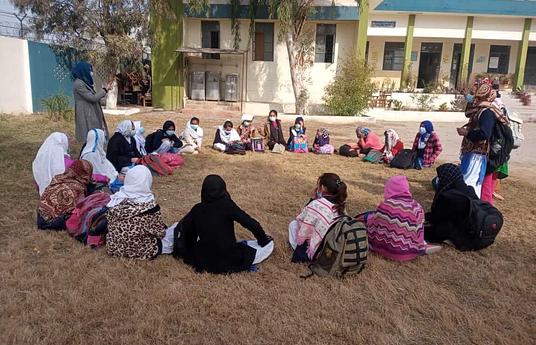
The Young Orators Club was established to address the barriers that hinder the development of English-speaking and communication skills among students studying in public schools.
The India Skills Report 2024 found that only 51% of graduates are employable. Which means that 1 in 2 graduates are not job-ready due to limited English proficiency and communication skills being major barriers. Likewise, the Mercer-Metti India Graduate Skill Index 2025 identifies inadequate English skills as a key factor reducing employability, particularly in non-technical roles.
Our 2024-25 Baseline Assessment found that 78% of students were at the Beginner level (speaking only in words or phrases with a shaky voice and signs of nervousness). Most students struggled to speak due to a fear of speaking in front of others.
Also we noticed that children from marginalized communities often reach adolescence with low confidence due to weak communication skills, limiting their classroom participation, higher education access, interview success, and livelihood opportunities.
These findings highlighted the need for the Young Orators Club (YOC) to create a safe, supportive space for students to build communication skills early. YOC was designed to shift this trajectory by offering structured, joyful opportunities through simple and engaging activities.
The Young Orators Club trains and empowers teachers and education officers in public schools with simple activities and practical strategies that create regular opportunities for all children to practice communication and speaking skills. We partner with district education departments, onboard government schools across the district, and work with students from Grades 3 to 8. One to two teachers from each school are trained two to three times during the academic year.
Teachers use the I Do (Teacher Demonstrate), We Do (students practice with peers), You Do (students practice independently) method to help students move from guided speaking to independent confident speaking. Mind maps are the prompts included in the lesson plans that help students organise ideas and speak in complete sentences.
Primary schools conduct two YOC periods each week, while high schools conduct one, each lasting 45 minutes. Students engage in Picture Talk, Show & Tell, Conversation, and Role Play activities. Implementation is supported through refresher trainings, school visits, classroom observations, feedback coaching, district reviews, and student showcases.
Endline Assessment in 2025-26, beginners (fragmented words/shaky voices) dropped by 29%, while Intermediate (4–5 sentences/emerging confidence) grew 15%, and Proficient (10–12 sentences/zero errors/clear body language) rose 14%. Students shifted from nervous, limited words to speaking in sentences.
YOC was launched as a pre-pilot project in 2-3 public schools of Narayanept district, Telangana in 2023 and by looking at the impact and growth it was expanded across Narayanpet and Vikarabad districts in Telangana, India in 2024. The program was spread through strong evidence and collaboration with district administrations, school leadership, and local education officers.
Major achievements in the last 1-2 years include:
1. Reached approximately 85,506 students across two districts.
2. Trained 15,70 teachers across 33 mandals
3. Conducted end of the year showcase where students displayed their communication and english speaking skills in front of large audience and district officials such as District Collector, District Education Officer, MEOs and teachers.
4. Schools organized mid-year showcases during PTMs in front of parents.
The program has demonstrated that communication skills can be built at scale inside government systems without expensive infrastructure.
Goals for the next 2-3 years:
1. Expand program reach to impact 1 million students
2. Integrate YOC strategies in other subjects such as social studies, science etc
3. Integrate the program in state curriculum
4. Build student leadership and debate pathways
Since launch, YOC has evolved significantly based on classroom realities and implementation learnings. Our pedagogy has gone through 2-3 iterations.
Our unique program pedagogy utilises a structured 45-minute scaffolded approach designed to transition students from observation to independent, confident communication. The class begins with a 10-minute Opening, where teachers use "Picture Talk" or "Show & Tell" to spark curiosity through 5W1H questioning (Who, What, Why, etc.). This is followed by a Gradual Release of Responsibility model: the "I Do" phase (5 mins) involves teacher modeling with visual cues; the "We Do" phase (5 mins) encourages collaborative pair-work; and the "You Do" phase (20 mins) empowers students to speak individually before the class, using native language support (Telugu) where necessary to bridge confidence gaps. The session concludes with a 5-minute Closing focused on appreciation and emotional reflection, ensuring a supportive environment for mastering English speaking and overall communication skills.
To execute this pedagogy, Master Trainers are trained who, in turn, train all the teachers.
We also learned the importance of prioritizing hands-on practice over theory during teacher training. This increased teacher confidence and improved facilitation quality.
These are the few steps one can take:
1. Pilot the model in a few schools to build yours and teachers' conviction in the methods.
2. Invite district officials to the classroom and let children show the growth.
3. Collaborate with the district officials and take necessary permissions for launching the project at scale.
4. Request officials to direct schools to dedicate one/two weekly speaking periods in the school timetable.
5. Plan and facilitate practice oriented training for teachers displaying how to use YOC activities step by step in the classroom.
6. In the first quarter, ask teachers to begin with Picture Talk and Show & Tell activities and then in the later half of the year focus can be on Conversation, and Role Play.
7. Provide a YOC handbook to teachers which includes required resources, it can be a digital copy or printed one.
8. Align with the middle leadership (MEOs, CHMs) to provide support to teachers at school level.
9. Ensure organizing an end year showcase bringing all the stakeholders together to show the magic of improvement in students communication and English speaking skills.