Cookie preferences

HundrED uses cookies to enhance user experiences, to personalise content, and analyse our web traffic. By clicking "Accept all" you agree to the use of all cookies, including marketing cookies that may help us deliver personalised marketing content to users. By selecting "Accept necessary" only essential cookies, such as those needed for basic functionality and internal analytics, will be enabled.
For more details, please review our Cookie Policy.
Accept all
Accept necessary
search
clear

Su-Art Math apparatuses for school math laboratories for Grade VI till X

place India + 1 more

Learning By Doing

Few intriguing queries to schools - Do you have Math labs in your schools? If you have one, do they have the right equipment/apparatuses that can facilitate inquiry-based learning in Mathematics? Do you have a system for validating and verifying math concepts and theorems? Su-Art has developed mathematics apparatuses for school math labs to facilitate experiential learning in the labs.

Overview

Information on this page is provided by the innovator and has not been evaluated by HundrED.

Updated March 2023
Web presence

2021

Established

1

Countries
Students upper
Target group
We aim to inculcate 'Learning by doing' in students and intrigue them with the mathematics phenomena they observe. We hope to better understand the mathematics concepts and theorems they are taught in their classes. It will help them collaborate with each other for better learning and build critical and design thinkers who are more organized in conceptual ideating and implementation.

About the innovation

Why did you create this innovation?

1. Absence of Math labs in schools.
2. Absence of appropriate apparatuses/equipment for math labs.
3. The idea of experiential learning in Mathematics but lack of execution.
4. To inculcate a systematic approach to inquiry-based learning in Mathematics.
5. A formal system of validating and verification of Math concepts for grades VI to X.

What does your innovation look like in practice?

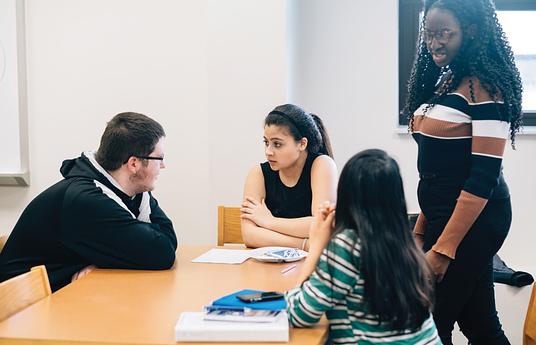
Students in groups of three to four assemble threads, screws, and protractors to construct figures and take out the data for accepting or rejecting the hypothesis (Math theorems). They then organize and tabulate the data and based on it, accept or reject the hypothesis.

There are also activities planned, where students can model the mathematical phenomena through provided cut-outs.

All activities are mapped to the CBSE curriculum of India. The topics that have been picked are generic and universal in nature and are taught across grades VI to X.

The method we suggest is to assemble threads, screws protractors on proprietary designed baseboards, to collect data and organize it, or work with provided cut-outs, and finally to explore, validate, verify, and model the math concepts and theorems that are taught in grades VI to X.

How has it been spreading?

In the last year, we have already supplied our Su-Art mathematics apparatuses to over 100 schools across the states of India.

In the next 2-3 years, we look forward to supplying the government schools through state government contracts across Indian states.

We have put up the manufacturing line to produce close to 500 math apparatuses a month.

If I want to try it, what should I do?

Subodh Vaishampayan - +91 9560701566

Rupesh Page - +91 9922962335
Implementation steps

Grouping
Group Apparatus baseboards with the respective accessory kit and the manual. Select the activity from the manual. Follow the instructions for the respective activity.
Activity
Construct the figures using the accessories as suggested in the steps given for the selected activity.
Data collection
Collect data for an individual activity set. For a single activity, multiple data collection sets through exprerimenation is suggested.
Organising and Tabulation
Organise the collected data and tabulate it.
Inference
Interpret and infer from the tabulated data.
Conclude
Accept or reject the hypothesis, or model the mathematical concept (that might be suggested at the beginning of the activity in the manual).

Spread of the innovation

loading map...