In Hong Kong schools, Education for Sustainable Development (ESD) is often treated as a dessert rather than the main course — something nice to have after the “real” academic work is done. The curriculum remains exam‑oriented, leaving little space for students to connect learning with the urgent environmental and social realities shaping their future. Teachers are expected to cover sustainability topics, yet few receive the time, support, or training to design meaningful interdisciplinary experiences. As a result, learning about sustainability often becomes fragmented, superficial, and disconnected from students’ lives.
We created SPARK to change this mindset and practice. Our innovation empowers teachers to become changemakers who integrate sustainability into the core curriculum of schooling, not as an add‑on. Through collaboration with experts and community partners, teachers co‑design authentic learning that combines scientific understanding, empathy, and action.
Beginning with ocean and coastal contexts relevant to Hong Kong, SPARK strengthens systems thinking—linking local environmental issues with global planetary wellbeing. We aim to turn sustainability from a special topic into a living practice, equipping educators and students to see themselves as active contributors to the planet’s health and their own collective future.
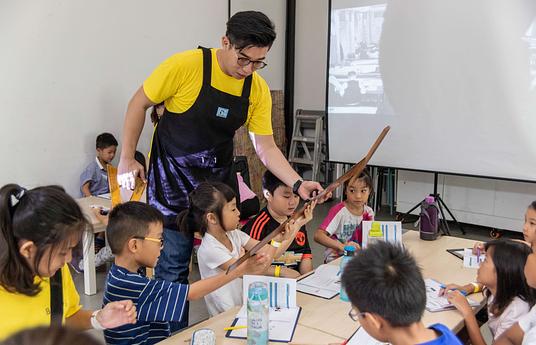
SPARK is a two-year professional learning and curriculum co-design programme that equips teachers to embed sustainability as lived practice in schools. Grounded in Project-Based Learning, teachers design interdisciplinary “Learning Expeditions” around a guiding question linked to SDG 14 – Life Below Water. Students explore real-world marine case studies through engaging entry experiences and producing meaningful final products, building creativity, problem-solving skills, and agency.
These expeditions connect subjects such as science, humanities, mathematics, and language, enabling students to integrate knowledge and develop practical responses to sustainability challenges. Teachers prototype, test, and refine curricula using student feedback, strengthening their confidence and capacity to facilitate inquiry- and action-based learning.
Cross-sector collaboration is central. Teachers co-create with environmental educators, marine scientists, and partners such as Outdoor Wildlife Learning Hong Kong.
Evidence from six pilot schools shows measurable impact. Teachers improved their understanding of ESD and marine biodiversity and increased confidence integrating SDG 14 into teaching. Students are developing stronger awareness of human impacts on marine ecosystems, greater interest in marine issues, and increased empathy and willingness to adopt sustainable behaviours through observation.
Over the past 1–2 years, this innovation has been piloted in six primary and secondary schools in Hong Kong as a school-based initiative. We focused on building a robust and replicable model through deep implementation, working closely with teacher teams to co-create interdisciplinary, real-world curricula and strengthen their capacity as curriculum designers. The model has spread within schools through sustained collaboration, supported by cross-sector partners with expertise in marine conservation and planetary health.
Key achievements include tailored SDG 14 curricula, with students producing real-world projects and solutions. Teachers gained confidence in designing inquiry-based, interdisciplinary curriculums. Students developed marine-related knowledge, skills, attitudes, and values, applying them to real-world problems. NGO partners shifted from one-off workshops to co-designing practical, school-specific learning. Full results are in the report.
Over the next 2–3 years, we will open-source the curricula developed by the six pilot schools and hold a series of dissemination activities to share our impact, inspiring awareness and action on marine conservation. Following our initial pilot, rising interest from additional teachers and schools will guide us to seek further opportunities, resources, and partnerships to expand our impact and scale interdisciplinary, real-world sustainability learning.
If you are a third-party organisation or intermediary, you can adopt the model by first identifying a clear planetary health focus (e.g., ocean literacy, biodiversity, climate resilience, etc.) that is locally relevant. Build partnerships with schools and cross-sector experts (NGOs, universities, industry), and organise teacher capacity-building workshops that introduce ESD principles, interdisciplinary curriculum mapping, and a “head–heart–hands” learning framework. Facilitate a co-creation journey in 6–12 months, including prototyping, coaching and reflection, as well as a one-year implementation to ensure sustainability is embedded into school curricula rather than delivered as one-off / extra-curricular activities.
If you are a school, start forming a small cross-disciplinary teacher team and selecting a relevant SDG theme connected to your curriculum and community context. You can take reference from the Learning Expedition developed by XP School or Golden Principles of Project-based Learning for curriculum design. Engage external partners to provide expertise and real-world perspectives. Pilot a small-scale prototype lesson or project, gather feedback from students, and refine the design before scaling across subjects or year levels. Strong leadership support and documentation are key to sustaining impact beyond individual teachers.