The earliest years of life are the most decisive and the most neglected.In Mexico, 18% of children aged 3–5 show inadequate development, and over 75% experience delays in literacy and numeracy.
These gaps are not inevitable , they are the result of a system that fails working families. Public childcare reaches only 4% of children under 3, and 93% of state preschools operate just 3–4 hours per day, completely disconnected from the reality of parents working long shifts in manufacturing, agriculture, or hospitality.
The consequences extend far beyond education. Without reliable childcare, mothers leave the workforce, 60% quit after pregnancy, and fewer than 10% return. Children lose their window for foundational development and communities lose human and economic potential.
We are aware that no single actor could solve this alone. Governments lack the reach, families lack the resources and companies were absorbing the hidden costs (absenteeism, turnover, lost productivity), without realizing childcare and education was at the root.
Hipocampus was built on a simple but powerful insight: if we align the interests of companies, families, and communities around early childhood education, we can create a system that is financially sustainable, pedagogically rigorous, and genuinely accessible, reaching the children who need it most, where they are.
Hipocampus operates an integrated system of early childhood education solutions , each designed to reach different populations, together creating system-level change.
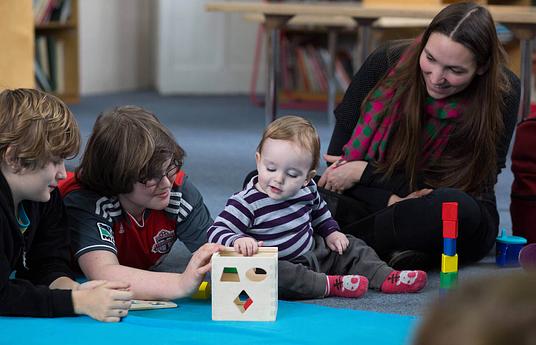
At its core, our employer-embedded Learning Centers place high-quality education directly in or near the workplace. Employers co-fund up to 92% of operational costs as an employee benefit, making it financially viable without depending on public subsidy. Centers serve children aged 1–6, operate extended hours aligned with shift work, and are open to the surrounding community, not just employees' families. Our pedagogy integrates Montessori principles, Constructivism, and Attachment Theory, adapted to local cultural contexts. Results are measurable: 100% of children show accelerated development within 6 months, and among those who entered below age standards, 93% showed progress across all developmental domains.
Beyond centers, our Digital Caregiver Support Program reaches families regardless of geography through WhatsApp-based communities, expert content, and behavioral nudges, achieving 77% retention and 92% active engagement. A philanthropy-funded Community Center ensures access for the most vulnerable families. And a pilot public-private partnership with IMSS (Mexico's Social Security Institute) is embedding our quality standards into existing public infrastructure, unlocking system-level scale. This architecture distributes access, making quality early childhood education resilient and scalable.
Since 2016, Hipocampus has grown at a compound annual revenue rate of 30.7%, demonstrating that financially sustainable early childhood education is achievable. We currently operate 8 employer-embedded Learning Centers across 7 Mexican states, partnering with companies including Grupo Bimbo, Driscoll's, IKEA, and Compartamos Bank serving 5,696 children and 5,387 caregivers, while employing 169 local women as professional educators.
Over the last two years, key milestones include: launching and scaling a Digital Caregiver Support Program reaching 2,100+ children and 1,350 caregivers across 3 corporate clients with 77% retention; securing long-term contracts with blue-chip employers; earning B Corp "Best for the World" recognition; and producing rigorous child development data, 93% of children entering below age standards showed measurable progress across all developmental domains.
Our growth architecture is now multi-channel: employer-funded centers, community-based philanthropy-funded centers, a digital program for dispersed populations, and a forthcoming public-private pilot with IMSS in 2027.
For the next 2–3 years, we aim to operate 14 employer centers and 3 community Learning Centers; scale our Digital Program to 10,000 caregivers annually; and pilot a B2B2G model through public infrastructure, reaching 1,500+ children per year with high-quality early childhood education and achieving financial self-sufficiency by 2029.
Over the past two years, the Hipocampus Learning Centers model has evolved from a single channel into an integrated system of complementary solutions with the purpose of reaching more children and families.
The model started with the Learning Centers in partnership with companies (B2B). Today this model operates across 7 states in Mexico, embedding high quality early childhood care. Based on this experience we identified the opportunity to expand, scale and guarantee the sustainability of the model through three significant innovations:
Learning Centers funded by Philanthropy: We operate a Center fully dedicated to low income families, ensuring access to high-quality early childhood care regardless of their economic capacity. The Center is located in a vulnerable community in Veracruz.
Public-Private Partnership: We are piloting a collaboration with IMSS (Institute of Social Security in Mexico) to embed our pedagogy and quality standards into existing public infrastructure. This unlocks system-level scale while preserving quality.
Digital Caregiver Support Program: We designed a tech-enabled program reaching caregivers wherever they are at home, in rural areas, or in companies with dispersed workforces, through WhatsApp-based communities, expert content, and behavioral nudges. It currently supports over 1,350 caregivers across 3 corporate clients, with 77% retention rates.
To adopt our model, contact us at german@hipocampus.mx to start working together.

.png)