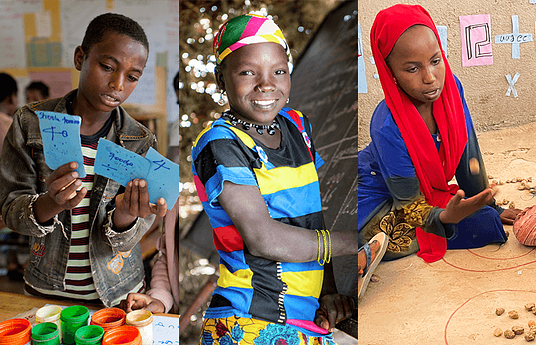
Data from countries around the world shows that learning poverty is disproportionately distributed and children in developing countries, particularly those living in emergency contexts are most affected. Therefore, we have designed FastTrack to provide foundational learning for out-of-school children whose education needs remain largely invisible due to insufficient data, resources, and support.
Our tech-enabled foundational learning innovation called FastTrack combines 3 proven independent teaching and learning approaches, including the Teaching-at-the-Right-Level (TaRL) methodology, a bilingual instruction model, and the talking book and pen; a specially printed book with unique dot patterns and a digital pen with audio capabilities that aids the bilingual model of instruction. Over a 6-month period, learning is facilitated by community-based facilitators/teachers and this model means that the ripple effects continue even after our work has ended, because the expertise and knowledge remain in the local community. An impact evaluation conducted in 2022 using quasi-experimental evaluation shows that the treatment group had an overall 76% increase in the number of children who made significant progress across different levels of literacy and numeracy, while the control group did not show any significant improvement even though they were exposed to other learning programs.
From winning TheirWorld's first ever innovation in education award to being selected as one of the 10 winners of the Jacobs Foundation and MIT Solve LEAP challenge, and now a semi-finalist for the Recoupling Awards, FastTrack has been recognized as a proven and sustainable intervention for improving foundational learning. Since the first pilot in 2019, we have deployed FastTrack to reach 12,000 children, improving foundational skills in literacy and numeracy 2 times faster than conventional classrooms. We are starting a new partnership with Theirworld to reach an additional 10,000 children across 2 years. By 2030, we plan to scale FastTrack to reach 1 million children across five African countries, including Rwanda, Kenya, Congo, Uganda, and Ghana.
The first step an organisation or individual need to take is to contact us to work together to conduct a contextual analysis survey to understand if our innovation is appropriate for their context. If the analysis result reveals contextual appropriateness, we will train the entity on how to implement our innovation and we give them our standard operating procedure (SOP).