Introduce yourself. Who are you and what is your relationship to education innovation?
My name is Vanessa, and it means butterfly. I have always loved that meaning because butterflies remind us that transformation is a natural part of life. They don't force flowers to bloom, they simply move gently from one flower to another, pollinating life wherever they go.
I often see this as a beautiful metaphor for my life. Like a butterfly, I have crossed many landscapes, cultures, and communities, not to collect experiences, but to pollinate ideas, connect people, and carry hope from one place to another.
For me, innovation is not primarily about technology or new methodologies. It is about creating the conditions for human flourishing.
I also see myself as a gardener of human potential. My work is to help create the conditions for people, communities, and ideas to flourish naturally. Like any gardener, I cannot make a seed grow. I can only prepare the soil, nurture relationships, cultivate love, kindness and trust, and believe in what is already alive inside each person.
My relationship with educational innovation comes from this way of living. For me, innovation is not primarily about technology or new methodologies. It is about creating the conditions for human flourishing. It happens when learning becomes more compassionate, more regenerative, more connected to nature, culture, community, and to our shared humanity.
I usually say that, before being a Brazilian educator or a sustainability consultant, I am a lifelong learner. Curiosity has always guided my life. Living in different contexts has taught me that education is not confined to schools, it happens wherever people meet with curiosity, respect, and openness. Meaningful education begins with relationships, love and a sense of belonging.
For more than 30 years, I have worked in different fields from corporate leadership to international education and community development. Over the past decade, I have lived and collaborated across five continents throughout 45 countries, learning with children and young people, indigenous communities, ecovillages, humanitarian organisations, governments, schools, educators and social innovators. Every place has transformed me as much as I hoped to contribute to it, where I have learned that every culture carries its own wisdom, and every community has seeds waiting for the right conditions to blossom.
For me, education innovation is not about creating something new for its own sake. It is about creating the conditions for every child, every educator, and every community to discover and express the potential that is already within them.
So, if I had to introduce myself in one sentence, I would say: I am a butterfly who gardens relationships, helping ideas, people, and communities blossom in ways that are meaningful, sustainable, and deeply human.
What motivated you to join the HundrED Academy? What keeps you coming back?
My journey with HundrED actually began before I became an Academy member. During my immersion at Green School Bali (one of the pioneering sustainable schools featured by HundrED), I experienced a different vision of education. As a learner, researcher, designer and facilitator of Green Educator Course, I witnessed how sustainability, purpose, wellbeing and experiential learning could become the foundation of an entire school culture rather than isolated projects.
That experience introduced me to HundrED's global community of innovators first as an Ambassador in 2018.
The Academy continually renews my belief that every child deserves not only access to education, but the opportunity to truly flourish.
What keeps me returning year after year is hope. Every review reminds me that, despite the enormous educational challenges we face worldwide, thousands of educators continue to imagine and build better futures for children. Reading their stories is both intellectually enriching and deeply moving.
Reviewing innovations is much more than an evaluation exercise. It is an opportunity to learn from extraordinary people working in completely different realities while discovering ideas that can travel across cultures and inspire impactful new possibilities elsewhere.
Each innovation plants a seed. Some seeds have already influenced projects I have facilitated in Africa, Asia, Oceania, Europe and Latin America. Others simply remind me that educational transformation is already happening, often quietly, inside classrooms, forests, villages and communities that rarely make international headlines.
The Academy continually renews my belief that every child deserves not only access to education, but the opportunity to truly flourish.
What has been the most memorable innovation that you have reviewed?
Choosing only one innovation after reviewing hundreds over eight Global Collections is almost impossible.
However, Talking Tree Hill, in Aotearoa New Zealand, holds a very special place in my heart because I had the privilege of experiencing it beyond the application itself.
Some of the most profound educational innovations are also among the simplest
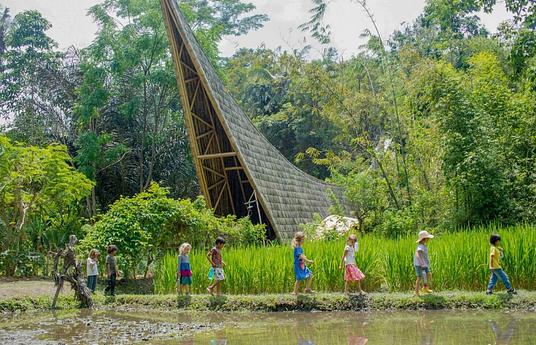
While volunteering on Waiheke Island, I was able to spend time with the programme and witness its philosophy in practice. Rooted in Māori perspectives and nature-based learning, Talking Tree Hill creates an environment where children develop confidence, resilience, empathy and a deep relationship with the natural world through outdoor experiences, storytelling and play.
It reminded me that some of the most profound educational innovations are also among the simplest. There are no sophisticated technologies or expensive infrastructures, only caring adults, meaningful relationships, nature and a genuine respect for children's innate curiosity.
Living that experience reinforced something I continue to see across many HundrED innovations: when children feel safe, connected and trusted, learning happens naturally.
Talking Tree Hill became part of my own educational journey.
What is your hope for the future of education?
My greatest hope is that education rediscovers its deepest purpose: not simply to prepare people for the world, but to help them care for it and for one another. Throughout my journey, inspired by educators such as Paulo Freire and by learning from indigenous communities across different continents, I have come to believe that education is, above all, about cultivating relationships and unity.
Relationships with ourselves, with others, with nature, with our communities, with those who came before us, and with the generations yet to come.
Rather than asking only "What should students know?", I hope we increasingly ask "Who are they becoming?" and "How will they contribute to a more compassionate, just and regenerative world?"
We live in a time of extraordinary technological progress, yet many societies are experiencing increasing loneliness, polarisation and disconnection. We have learned how to produce more information, but not necessarily more wisdom. We have become highly connected digitally, while often feeling disconnected as human beings. I hope education will help restore this balance.
Rather than asking only "What should students know?", I hope we increasingly ask "Who are they becoming?" and "How will they contribute to a more compassionate, just and regenerative world?"
Again, for me, learning is not about manufacturing successful individuals. It is about creating the conditions in which every person can flourish, much like a healthy forest does not force trees to grow, but provides the relationships, diversity and care that allow life to emerge naturally.
This is why I believe the future of education lies less in delivering answers and more in nurturing curiosity, dialogue, critical consciousness and shared responsibility. Paulo Freire reminded us that education is an act of hope. I would add that it is mainly an act of love and care. My hope is that schools become living ecosystems where academic learning and human flourishing are inseparable; where children are not only encouraged to think critically, but also to feel deeply, cooperate generously and care courageously.
If education can help us rebuild the invisible infrastructure of human relationships: trust, empathy, belonging and love in action, I believe we will not only prepare children for the future. We will help them create a future truly worth living.
Want to join the HundrED community? Become an ambassador or join the academy to review innovations in future calls.