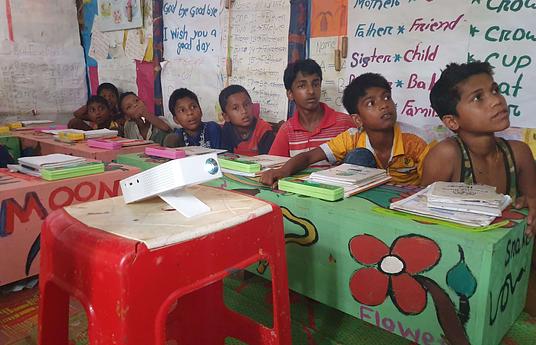
Wokober Learning Approach was developed to addresses the lack of engaging, relevant, and personalized learning experiences in underserved schools and communities in Uganda, which leads to poor learning outcomes, early dropout, and limited life opportunities. These communities face inadequate access to teaching and learning materials, underexposed teachers, and overwhelmingly large classrooms with a learner to teacher ratio of 63:1, limiting learners’ opportunities to develop the creativity, practical skills, and innovative and self-development competencies needed to thrive in today’s dynamic world.
In Northern Uganda where Wokober Education Foundation is headquartered, over 1.2 million children are out of school, and only 54% complete primary school. Coupled with the region’s recovery from over 2 decades of conflict, there is 80% unemployment and poverty at 70% (UNPA 2023).
Our short-term outcome is to improve learner engagement and foundational competencies by equipping educators with AI-powered tools that deliver personalized, project-based learning experiences rooted in local innovation. Our long-term outcome is to nurture a generation of confident, skilled, and entrepreneurial young people who can break cycles of poverty, drive community transformation, and succeed in the 21st-century workforce.
Wokober Learning Approach session is an imaginative, fun, explorative yet structured learning experience for children aged 3-18 years (grouped in 3-7, 8-12 and 13-18). A typical session follows the five progressive learning modules each designed with unique learning outcome that holistically develop a child.
It begins with Exposure, where learners are taken for study tours within their communities, to observe new innovations, understand challenges and appreciate diverse perspectives (https://youtu.be/N5ZrfLwxEWo). During Ideation, they explore fun ideas or generate solutions to real-world problems. In Creation, they develop their ideas using recycled and local materials, developing practical hands-on skills (https://youtu.be/U2Bvx0xj_-4).
In the Product Application module, learners reflect on how their creations can be used, shared, or monetized, instilling a sense of purposeful creation and entrepreneurship. Leadership Development builds personal growth through goal-setting, self-reflection, communication, and presentation skills.
Teachers are supported by Wokoverse, an AI platform that guides lesson planning, tracks learner progress, and provides real-time insights, empowering them to deliver personalized, project-based learning to learners.
Throughout the program, learners engage in long-term personal projects, community events such as the Toy and Innovation Festivals, where they showcase their work and connect to the general community (https://youtu.be/pO1cD-aX7p0).
Spreading the Wokober Learning Approach (WLA) has been organically through local pilot programs, community engagement events, and partnerships with schools, NGOs, and learning centers.
Our journey began in 2022 with a Toy and Innovation Festival in Gulu, where we tested the community’s response to locally inspired hands-on, play-based learning. The event attracted 69 paying participants and 50 parents, and their feedback helped co-develop the WLA, tailored to three learner age groups (3-7,8-12,13-18).
In 2023, we piloted WLA with 15 learners. The positive results allowed for a refined model and expansion in 2024 to reach over 350 learners and 20 educators across multiple settings.
In November 2024, WLA won first prize in medal of excellence national award, which enabled a partnership with innovation consortium to scale it in Kampala in 3 learning centres and 4 schools, reaching 950 learners. Wokober have also drawn the interest of development partners like Save the Children, Elephante Commons, Compassion International and GWED-G, who recognize WLA’s potential to complement Uganda’s new competency-based curriculum.
Community-driven events such as Toy and Innovation Festivals have become a powerful catalyst for spreading WLA and so far have indirectly impacted over 15,000 learners and community members (https://youtu.be/IbbLcByHaME).
As demand grows, we’re positioning WLA and Wokoverse to scale regionally across Uganda, adopted by Ministry of Education and across Africa.
Wokober has evolved significantly since its inception, driven by real-world feedback from learners, educators, parents, and community partners. What began as a grassroots initiative focused on toy-making and creative exploration has grown into a structured, multi-module learning model supported by technology.
Initially, the Wokober Learning Approach focused on hands-on learning through local materials and community-driven mentorship. Based on early testing with 15 learners in 2023, we recognized the need for more structure to guide facilitation and deepen learning outcomes. This led to the development of WLA’s five core modules: Exposure, Ideation, Creation, Product Application, and Leadership Development, offering a clear progression from curiosity to innovation and self-growth.
In 2024, as WLA expanded to over 350 learners, we encountered challenges with tracking learner progress and providing personalized support across large, under-resourced classrooms. In response, we began developing Wokoverse, an offline-first AI-powered platform that empowers facilitators with tools for lesson planning, learner profiling, real-time assessment, and adaptive instruction, even without internet.
We’ve also adapted our facilitator training programs to better align with Uganda’s new competency-based curriculum, and introduced long-term learner projects and community exhibitions to increase ownership and visibility of learning outcomes.
If I want to try it, what should I do?