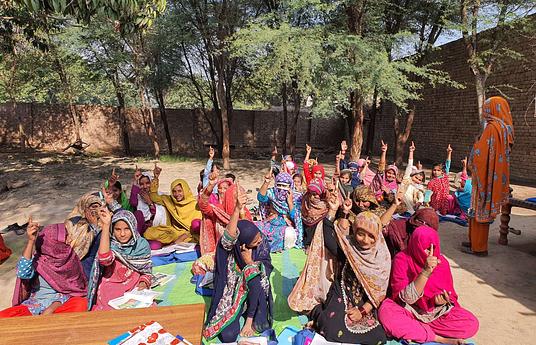
We created this innovation out of urgent necessity. The Rohingya, the world's largest stateless population, were being systematically denied education and a voice. Decades of persecution led to widespread adult illiteracy (around 90%), severely limiting their ability to advocate for their rights. In the refugee camps, the mandated Burmese-language curriculum was completely inaccessible, not understood by students or the few available teachers, creating a vacuum where children were vulnerable to trafficking and extremism. The problem was a language barrier blocking all learning. Our innovation addresses this fundamental issue: to provide meaningful, rapid literacy using the children's mother tongue to unlock the official curriculum. By restoring literacy and self-esteem, we aim to empower the next generation of Rohingya to achieve dignity, preserve their cultural identity, and ultimately, advocate effectively for their future on the global stage. This was not just about education; it was about ensuring the survival and empowerment of a forgotten people.
In practice, our innovation is a unique, two-part curriculum solution delivered in COTE learning centers. Firstly, we teach children to read and write in their native language using the highly effective Hanifi script . The Hanifi script is an alphabet developed specifically for the Rohingya language in the 1980s by Mohammed Hanif. It is a simplified, phonetic script, modeled on the Arabic alphabet but designed to perfectly map to the sounds of the Rohingya language, unlike previous attempts using Arabic or Latin characters. This simplicity is key: children achieve functional mother-tongue literacy in just 6 to 8 weeks. Secondly, and crucially, we have translated the official, mandatory Burmese curriculum textbooks. The pages now display the Burmese text alongside the Hanifi script translation. The Hanifi script acts as a 'helper language,' a cognitive bridge, that allows children to instantly understand the content that was previously impenetrable. This model transforms a meaningless textbook into a comprehensible learning tool, leading to the remarkable result of students scoring 78% higher on official exams than their peers. The look of the innovation is therefore a set of translated, dual-script learning materials that redefines accessibility in the classroom.
The spread of our innovation has been driven by both its demonstrable success and our commitment to open-source sharing. We initially implemented the model in our own learning centers, supporting 6,000 children and achieving profound results and high retention rates. The success quickly gained traction, with both the Bangladesh government and the Rohingya communities firmly backing the mother-tongue language materials. Our spreading strategy is not through franchising, but through broad adoption by the sector. Our ambition is to open-source the entire package, our translated curriculum, paper-based books, and digital resources, making it readily available to all other education providers operating in the camps, potentially reaching a further 342,000 children. Furthermore, we are working with a coalition of Rohingya civil society groups to promote Hanifi script adoption globally as a tool for unity and cultural identity. Because the model teaches the fundamental language script, it is highly replicable and effective for any Rohingya community around the world, providing literacy and cultural connection regardless of their host country's curriculum. The innovation's effectiveness and its open, replicable design are the primary engines of its spread.
Our innovation began with the Digital Education Model, piloted in 2019. Recognizing the language barrier, we created translated video lessons by dubbing the required Burmese curriculum content into Rohingya and projecting them. This was a massive initial step: children, seeing lessons in their own language for the first time, were engaged and found the content extremely easy to understand and engage with. However, while visual learning provided comprehension, we realised that it didn't teach them to physically read and write. We therefore modified the programme by introducing the Hanifi script as a core foundation. This new component actively builds on our existing digital infrastructure. Video lessons still complement the literacy lessons and bring them alive, but the Rohingya language lessons are fundamentally changing the way children can learn, and opening up myriad possibilities for Rohingya community literacy as a whole.
If you or your organisation are looking to understand or adopt this replicable education model, we encourage you to get in touch directly to explore collaboration and resource sharing.
How the Hanifi Script Works: The Hanifi script is the dedicated alphabet for the Rohingya language, designed for quick learning and effective teaching.
Teacher Training: Before implementation, Rohingya teachers are trained in the script. This ensures they can confidently teach the system and support the children, reversing the issue where teachers themselves cannot read the official curriculum.
Right-to-Left and Phonetic: The script is written right-to-left and is entirely phonetic, meaning it directly matches the sounds of the spoken language. It uses 28 consonant letters and 5 clear vowel letters. Special marks are used to indicate tones or elongated sounds, simplifying the structure compared to older writing systems.
In the Textbook: The script is integrated into the curriculum by being placed directly alongside the Burmese text in the official textbooks. This dual-script method allows students to use their easy-to-learn mother-tongue phonetic knowledge to access and fully comprehend the otherwise inaccessible official lessons.
We are looking to share this successful model. If you wish to access the translated curriculum, teacher training materials, or digital resources, please get in touch with the Children on the Edge team.