Class Saathi was created to solve a problem that most edtech ignores: millions of children sit in classrooms for years while their teachers never know they are falling behind. Learning failure in under-resourced schools is silent and invisible, surfacing only when it is too late to reverse.
Founder Pankaj Agarwal grew up attending the same under-resourced rural schools that Class Saathi now serves. After a career at Samsung and studies at IIT Kanpur, Seoul National University, and Harvard Business School, he returned to his village and found nothing had changed: the same cracked blackboards, the same disengaged students, the same data blindness.
The core problem was structural. At 50:1 student-teacher ratios, no teacher can identify who is lost through intuition alone. And 2.6 billion people remain offline, meaning the edtech tools designed to help simply do not work where the need is greatest.
Class Saathi was built to close that gap: to give every teacher, in every offline classroom across the world, a real-time picture of every student's learning, without internet, without expensive infrastructure, and at a cost of under $5 per student per year.
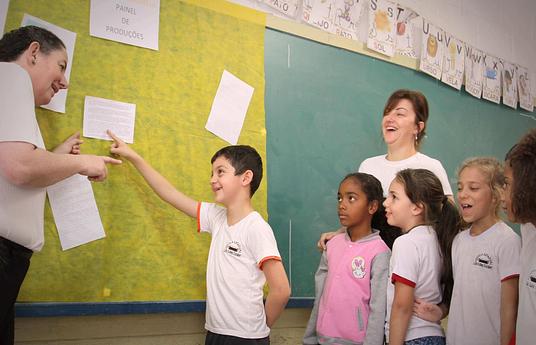
In a typical Class Saathi classroom, students each hold a small, low-cost Bluetooth clicker. The teacher poses a question through a lightweight app on any device, including an old Android phone, a projector, or a smart TV. Students respond in seconds, and the teacher's screen instantly displays a live comprehension heatmap showing, by name, who understood and who did not.
No internet is required to run assessments. The system runs entirely on Bluetooth, with a 12-month battery life and compatibility across Android, iOS, Windows, and Linux. When connectivity does return, all data syncs to the cloud for longitudinal tracking.
The AI does not just collect responses. It surfaces patterns, groups students by need, and generates specific remediation suggestions: which student is struggling with which concept, and what to do next. A teacher managing 78 students, including four with visual impairments, can engage the entire class simultaneously and cut grading time by 80%.
For students with disabilities, audio support, adjustable pacing, and tactile interfaces ensure equal participation. Every student answers. Every response becomes data. No one is invisible.
Class Saathi has grown from a single-country pilot to a validated, multi-continent solution operating in 15,000 classrooms across 7 countries: India, South Korea, Malaysia, Thailand, Vietnam, South Africa, and Poland.
In India, it is deployed across 660+ Jawahar Navodaya Vidyalayas, the national government school network, and is active in 5 states including Uttar Pradesh, the world's largest school system. It is used by elite private schools like Vasant Valley in Delhi, last-mile nonprofits like Pratham in remote villages, and in conflict zones through NGO partners.
Revenue grew 3.7x in two years, from $485K to $1.78M annually, reaching profitability in Q1 2026. The model sustains itself through government contracts (50% of revenue), direct B2B private school sales (40%), and strategic NGO partnerships (10%), with an 85% annual subscription renewal rate.
Growth has been recognised globally. Class Saathi was selected as MIT Solver 2025, inducted into the UNICEF Learning Cabinet, and named to the HundrED Global Collection 2026. Seed funded by Samsung in 2017, it raised a Series A in 2021.
Class Saathi has evolved continuously, shaped almost entirely by the teachers and students it serves. 90% of all product features originate from user requests, and every update is field-tested before rollout through 500+ monthly teacher touchpoints in the "Voice of Educator" program and student design councils in 20 pilot schools.
Key additions since launch include AI-generated quiz content pulled directly from textbooks, reducing teacher preparation time; automated parent progress reports delivered when connectivity allows; and an administrator dashboard giving schools and districts a system-level view of learning outcomes. Madhya Pradesh now uses Class Saathi data to power state-level "Learning Heatmaps" that track student progress at the school level.
On the hardware side, the clicker has been customised for braille input and additional accessibility buttons for neurodiverse learners. Battery life has been extended to 12 months, four times longer than comparable devices. The software now runs on devices as old as 8 years, reducing both cost and e-waste.
Local manufacturing was introduced in 2025, cutting the cost of goods by 12% and supporting sustainable unit economics as the solution scales globally.
If you’d like to try Class Saathi, it’s very simple.
For schools: You can request a demo kit that includes our student and teacher clickers, a USB dongle, and access to the software. We’ll help you set it up and run a trial in your classroom so you can see the impact firsthand.
For teachers and parents: You can download the Class Saathi app (Android/iOS) and access practice questions, assessments, and homework modules aligned to curriculum.
For partners: You can connect with us directly to explore pilot programs, content integration, or bundling with your existing solutions.
We provide full onboarding support, training, and real-time dashboards so you can immediately experience how Class Saathi improves participation and learning outcomes.
You can visit our website at https://tag-hive.com/ to learn more, and contact us via the details there or through our social media handles for a demo and collaboration.